Showing posts sorted by relevance for query bosch. Sort by date Show all posts

Sunday, April 15, 2018

TV Review: “Bosch” Season 4 is Taut Noir Cool


A couple of months ago I had a blog post titled “You Should Be Watching Amazon’s ‘Bosch’." Not only do I believe it is the finest show in Amazon’s Prime Video lineup, I think it is one of the best detective procedurals today. 

Season 4 of “Bosch” debuted on the streaming platform on Thursday, April 12 (earlier than the announced release date of April 13). Bridget and I stayed up until 1 a.m. last night finishing all 10 episodes. 

The latest season doesn’t dissuade my effusive feelings for the show. In fact, the fourth season of “Bosch” might be the best of the series. 

Detective Harry Bosch is back...and on the case. 

This season finds our protagonist investigating the murder of a lawyer named Howard Elias (Clark Johnson) who was prepping for a court case involving brutality claims against the LAPD. 


Elias has a reputation for taking on the department. As such, there is concern that a cop gunned down the unwary attorney on “Angels Flight” — a quaint tram located in the Bunker Hill district of Los Angeles. (This season is based on Michael Connelly’s novel “Angels Flight.”) 

Bosch is put in charge of a task force working to dig up clues and bring the murderer to justice. Their job is made all the more difficult by civil unrest in the community, politics within the police department, and issues in Harry’s personal life. 


What I find so refreshing about “Bosch” is the fact that the show works to “keep it real.” Authenticity is a hallmark of Connelly’s novels. 

In an era where police procedurals have become somewhat lazy as it regards “rapid forensic proof” and “super computers” that churn out ludicrous results, it is nice to have a detective show that deals authentically with the “analog realities” of police investigations. 

Like the previous seasons of “Bosch,” the fourth outing in the series features multiple threads twisting, turning, and ultimately converging into an intricately woven plot that requires thoughtful analysis from the viewer. 


It is wonderful to see a show so deftly work to hook viewers into the investigation. You feel like you’re right there alongside the terse and dogged Bosch as he questions suspects, slogs through boxes of evidence, analyzes security camera footage, and puts shoe leather to pavement in pursuit of the truth. 

At the show’s core is Titus Welliver — a perfectly cast actor who was hand-picked by the author to play the titular character Hieronymus “Harry” Bosch. 

Welliver brings a sensibility to the show that adds to the authenticity. 

Being reliable is the name of the game for each season of “Bosch.” The show is stylish because it is inherently unstylish. This isn’t a tome that relies on fancy transitions or extreme color grading in its execution. 

Instead, “Bosch” goes for the lived-in look, presents Los Angeles as it is, and chooses actors who look like regular people. 


Other standout performances this season include Madison Lintz (as Bosch’s daughter Maddie), Paul Calderon (as the feisty Det. Santiago Robertson), Lance Redick (as Deputy Chief Irvin Irving), and Jamie Hector (as Det. Jerry Edgar). 

But what makes the show such an interesting tapestry is the small roles and supporting players stitched into the various story arcs. 

For example, we gained more insight this season into the “Koreatown Killer” (a thread started in the third season). 

If you haven’t watched “Bosch,” I encourage you to check it out. It is available for Amazon Prime subscribers (for all you videophiles out there, all four seasons of the show are also available to stream in 4K). 

“Bosch” is taut noir cool. 

Tuesday, February 13, 2018

You Should Be Watching Amazon’s “Bosch”


I consume a considerable amount of detective fiction. 

My love of the genre started when I was in third grade and I pulled the Hardy Boys novel “The Secret of the Old Mill” off a bookshelf attached to my bedroom wall in the two-bedroom apartment my family lived in at the time. 

I quickly became fascinated with the finer aspects of detective work, and enjoyed the various tropes the genre had to offer. This was the 1980s — a time when shows about private investigators and police officers dominated network television. 

One of today’s finest writers in the detective genre is Michael Connelly. His novels focusing on Detective Hieronymus ‘Harry’ Bosch are among the best procedurals — meticulous and authentic in their research, tone, and style. 

The first Connelly novel I read was “Lost Light” in 2003. I was immediately hooked. Connelly’s brooding, noirish feel harkened back to classic detective fiction. His main protagonist was incredibly compelling.

Amazon decided to turn the exploits of Harry Bosch into a TV series on its Prime Video streaming service a few years back. The first season of “Bosch” debuted in 2014, and Amazon just announced the fourth season of the show — set to drop on April 13, 2018. 


My wife and I love the series, and consider it to be one of the finest detective shows around. 

Here is the trailer for “Bosch” Season 4:


The show feels authentic (Connelly insisted they shoot on location in Los Angeles). The beating pulse of the series is provided by actor Titus Welliver, who plays the title character. 


Welliver’s portrayal of Harry Bosch is pitch perfect. While the intense detective is dogged in his pursuit of justice, he isn’t the pat “anti-hero” often seen in the genre these days. 

He’s hard-boiled without being overdone. 

There is a quiet intensity to Welliver that serves the series well. He might not be a performer you’re readily familiar with, but his work as a character actor over the years makes him instantly recognizable. 

In my mind, Welliver’s performance is Emmy worthy, and he should receive more accolades. He adds a certain edge to the character that is neither cliche, nor obtrusive in any manner. His version of Bosch is honed smooth like a fine blade.  


There are other notable performances in the cast. Jamie Hector is terrific as the unassuming Jerry Edgar (Bosch’s partner in the LAPD) and Lance Reddick provides a stoic intensity as Deputy Chief Irvin Irving — a man navigating the tricky waters of law enforcement and Los Angeles politics. 


Amy Aquino plays Lieutenant Grace Billets — Bosch’s immediate superior, friend, and confidante. Aquino is excellent in the role, and provides a nice counter-balance to Harry Bosch. 


One of the interesting aspects of the series is that the show pulls from a “mashup” of Connelly novels — slicing and dicing his procedurals into each season’s story arcs.

In this clip, Connelly discusses the novels that will be featured in the fourth season of “Bosch”:


That technique is a nice touch. It allows readers to see familiar plot points and established pillars of character development, but it also means each season feels like its own unique thing. 


One of my favorite aspects of the series is the development of Harry’s personal life — in particular, his relationship with daughter Maddie (Madison Lintz). Not only do these threads humanize Bosch, they help keep the melancholy character grounded. 

Another thing I like about the series is the opening title sequence. I know that might seem trivial, but growing up in the 1970s and 80s exposed me to a number of excellent title sequences, and my feeling is that they add a key bit of punctuation to a television series. 

The “Bosch” title sequence features the song “Can’t Let Go” by Caught A Ghost — played over a kaleidoscope of Los Angeles images. There is sort of an OCD quality to the song, and the overall sequence sets a nice tone for the show:


There are number of quality shows for viewers to consume these days, and I know time is limited. I highly recommend you consider adding “Bosch” to your “must-see” list. 

It’s nice to see Michael Connelly’s vision come to screen — in a manner that stays true to the stories told on the printed page. 

I think it is the finest “original” in Amazon’s lineup, and is definitely worth your time.


P.S. - Titus Welliver recorded a video message about the fourth season of "Bosch" on his Twitter account today (Feb. 13, 2018)... it includes some good news about a fifth season of the show. 

Interested in Amazon Video? Try Amazon Prime for 30 days for free by clicking on the ad!


Sunday, June 17, 2018

Amazon’s “Jack Ryan” Series: Thoughts on the New Trailer and Author Tom Clancy


I had the opportunity to read my first Tom Clancy novel (“Patriot Games”) in the spring of 1989 as part of a high school literature class assignment. I quickly became a fan of the author’s techno-thriller stories, and went on to read “The Hunt For Red October” and “Clear and Present Danger” that summer... and have kept reading the “Clancyverse” novels ever since. 


(I even had the opportunity to see Tom Clancy speak in person at Omaha's Ak-Sar-Ben Coliseum in the fall of 1990).


In the intervening years, fans got to see Clancy’s novels get adapted for the big screen, and even saw the author attempt to develop a story for TV (“Op Center”).

When I saw Paramount’s “The Hunt For Red October” at Cinema Center on March 2, 1990, I thought Alec Baldwin was solid in the role of CIA analyst Jack Ryan. It’s a shame things didn’t work out for Baldwin to return for future movie installments.

While Harrison Ford did a fine job in “Patriot Games” and “Clear and Present Danger,” he just wasn’t Jack Ryan. Neither was Ben Affleck. Chris Pine also didn’t fit the bill (that said, “Jack Ryan: Shadow Recruit” was a pretty good movie). 

(Clancy's commentary track on the Blu-ray of "The Sum of All Fears" is pretty interesting.)

Sadly, Clancy died on Oct. 1, 2013. I was wondering if anyone would attempt another Clancy-based reboot for the big screen. 

It appears the future for filmed Clancy stories is in the burgeoning realm of streaming. 
Amazon is bringing the first season of “Jack Ryan” to its video platform on August 31. The series has already been renewed for a second season: 


They have tapped John Krasinski to play the titular role. I think he could be fantastic playing bookish government analyst Jack Ryan. If the full trailer (which dropped on June 11) is any indication, it should be a terrific series. 

The territory they’ll be exploring in the first season looks fairly topical for today (dangerous terrorist waiting to wreak havoc on the western world). I do hope — in true Clancy style — that the show will weave multiple threads together to create a large, geopolitical scenario for Ryan to be embroiled in. 


I’d also like to see characters John Clark and Domingo Chavez (and their anti-terrorist team “Rainbow Six”) included in the series. 
 
It will be interesting to see how the show turns out. The Amazon series “Bosch” (based on the novels of Michael Connelly) is one of my favorite programs these days (Titus Welliver is perfect as Hieronymous “Harry” Bosch in the series). 

It’s obvious the creators of “Jack Ryan” have taken liberties with their source material (that's to be expected). Regardless, I have high hopes for the series. 


Wednesday, December 29, 2021

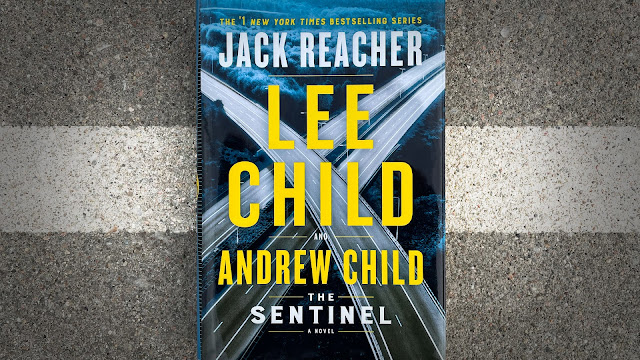
Book Review: Tech at the Center of “The Sentinel” By Lee Child and Andrew Child


“I’ve been in trouble before. I survived. And right now I have bigger fish to fry.” — Jack Reacher in "The Sentinel"

In early 2020, author Lee Child (née James Grant) announced that his brother (author Andrew Grant) was going to take over writing duties for the Jack Reacher series. 

I recall having mixed emotions at the time. I talked about the change in my review of Child’s 24th Reacher novel “Blue Moon.” Child mentioned that he and his brother would collaborate on the next few books together — before Andrew took charge of the series. Due to the fact that I was pretty underwhelmed by “Blue Moon,” I was worried that perhaps the pair was already collaborating. 

I just finished reading the first novel in this new arrangement, titled “The Sentinel.” Andrew Grant — an established author in his own right — is now credited on the cover under pen name “Andrew Child.” 

I’ve previously reviewed eight Reacher novels on this blog (as well as the short story collection “No Middle Name”). For some reason, I put off starting “The Sentinel” for more than a year after its initial publication. 

I think I was worried about the transition to a new writer (even if that writer came from the same gene pool as Lee Child). I know there have been various series over the years that have seen writer transitions such as this (some more successful than others), but there is such a distinctive personality to a Jack Reacher novel — in terms of characterization, story structure, and writing style — that I was worried I’d be disappointed. 

Let me say first off that “The Sentinel” is a far stronger entry in the Reacher lexicon than 2019’s “Blue Moon.” It has a vibe that feels authentic in the Reacher universe. 

This time out, Reacher finds himself in the small town of Pleasantville, Tennessee, after successfully guiding an insurance negotiator (who was driving around lost in Nashville) to an I-40 onramp. 

At first, I thought naming a sleepy little Tennessee burg “Pleasantville” was an uninspired choice (considering the fact that it is the same name as a 1998 movie starring Tobey Maguire and Reese Witherspoon), but it turns out there is actually an unincorporated community in Tennessee called Pleasantville. 

(While I thought naming a pair of fictional towns “Hope” and “Despair” in the novel “Nothing to Lose” was a tad bit hokey, at least it felt more original than “Pleasantville.” But I digress... )

The unassuming Reacher soon finds himself embroiled in a mystery shortly after his arrival at a Pleasantville coffee shop (a situation that is de rigueur for the former military police officer). 

Reacher stumbles upon a man departing the coffee shop named Rusty Rutherford — a local IT specialist. 

Reacher pays the man no mind, but soon “a signal from some ancient warning system in the back of his brain” causes his interest to ratchet up. 

His keen intellect detects a coordinated attack unfolding to snatch Rutherford (involving two men and a woman). Reacher’s MO is to help the unwary stranger.  

In mere moments, Reacher finds himself running afoul of those attempting to ambush Rutherford as well as the local constabulary. All parties seem anxious to shoo Reacher out of town. 

But our hero is persistent. 

Reacher learns that Pleasantville has been hit by a ransomware attack, and Rutherford (the town’s recently terminated IT manager) is being blamed. 

Despite Rutherford’s urging, government officials failed to invest in a more robust IT infrastructure, making the town a “soft target” for hackers and bad actors. Instead of using Rutherford to help solve the attack, the town has turned him into a local pariah — despite his intricate knowledge about such security breaches. 

All of this sets into motion a mystery wrapped in a conspiracy that has its tentacles winding beyond the boundaries of Pleasantville.

In the middle of the storm is our luddite knight errant, Jack Reacher. 

In a two-part interview with The Crew Reviews about “The Sentinel” (watch Part 1 and Part 2), Lee Child hinted that he was handing writing duties over to his younger brother because he wasn’t equipped to keep Reacher fresh for a younger audience. 

You can definitely see attempts to try and infuse more of today’s technology into “The Sentinel” — we even see Reacher nudged into using a cell phone. I don’t know for sure if Lee and Andrew intentionally went with a more “tech-heavy” focus to appeal a more “tech-savvy” audience or not, but it made me wonder. 

For the most part, the tech-based plot worked. There were some instances (such as a few too many successful attempts at cracking 4-digit security codes) that pushed the boundaries of “willful suspension of disbelief.” 

It is a trait that is fairly common with modern thrillers, so it is a minor quibble. 

To be honest, I prefer my Reacher novels to be less tech heavy. That’s the joy of this series. And I’m speaking as someone who has spent a significant portion of his adult life building websites and crafting promotional efforts online. 

I feel that technology has become something of a crutch when it comes to storytelling these days (and in many entertainment properties, computers have turned into “deus ex machina” plot devices that make detective work far too easy). 

One interesting note: In the earliest passages of “The Sentinel,” we find Reacher aiding a Nashville-based band that has been cheated after a gig by bar owner named Derek Lockhart. 

It almost seemed as if that was going to be the circumstance Andrew Child used to set the story in motion (I could have seen a scenario where Reacher unearthed some sort of conspiracy involving an organized crime ring helmed by Lockhart... or something of that nature). It ultimately turned out to be unrelated to the rest of the novel... 

I had a good time reading “The Sentinel.” While it might not rank among my favorite Reacher novels, it was a fun read that felt at home with the rest of the series. I’ll be interested to see how Reacher evolves as Andrew Grant’s influence is reflected in upcoming stories. 

Overall, I am happy the series is continuing and I think things are in capable hands. 

In other Jack Reacher news...

The new Amazon Prime Video series “Reacher” is set to drop on the streaming service Feb. 4, 2022. The first season runs eight episodes and is based on Child’s first novel “The Killing Floor.” 

I’m looking forward to the show and think actor Alan Ritchson embodies the Reacher look. It will be interesting to see if the overall execution of the show itself is as solid as Amazon’s other book-based detective series “Bosch” (read my 2018 post “You Should Be Watching Amazon’s ‘Bosch’”). 

>> If you enjoyed my review of “The Sentinel” by Lee Child, follow me on X/Twitter: @TheJonCrunch 

Here is the teaser trailer for “Reacher”: 


Additional blog posts on author Lee Child:


Thursday, May 28, 2020

TV Review: Is Amazon’s Sci-Fi Comedy Series “Upload” Worth Watching?


I’m going to say upfront that the Amazon Prime Video service is one that I’ve never really “loved.” 

Sure, there are a couple of the service’s original series — “Bosch” and “Jack Ryan” — that I’ve really enjoyed the past few years. 

But a lot of the original content failed to grab me. 

I’m sure that’s an unfair sentiment on my part. I’d imagine many of you have worthwhile recommendations you could make. 

Bridget and I decided to try the new sci-fi comedy series “Upload” based on a number of commercials we’d seen for the show on network television. 

“Upload” was created by Greg Daniels, the mind behind the U.S. version of “The Office,” “Parks and Recreation,” and “King of the Hill.” He is also the creator of the Netflix series “Space Force.”

“Upload” takes place on Earth in the near future (2033 to be exact) and tells the story of a world where people have the ability to upload a digital version of themselves into a digital afterlife of their choice. 

Some people are better able to afford a comfortable afterlife than others (similar in concept to varying funeral ceremony and burial arrangements of the present). 


The show’s protagonist is Nathan Brown (Robbie Amell, who I’d describe as a “low rent Tom Cruise”), a 27-year-old computer programmer who sustains fatal injuries in a freak car accident and ends up in Lake View, a ritzy resort world that is considered one of the best afterlife options. 

His girlfriend Ingrid Kannerman (Allegra Edwards), a wealthy socialite, foots the bill for Nathan’s stay, hoping they’ll be able to eventually spend all eternity together in Lake View.  


Much of the first season of “Upload” is dedicated to Nathan adjusting to “digital heaven.” 

The immersive afterlife is something akin to the world featured in the Kristen Bell comedy “The Good Place.” In fact, the whole vibe of “Upload” is similar in nature (except it leans more toward the sci-fi end of the spectrum and is less fantastical). 

Nathan initially feels listless in his new environment, but soon forges a special bond with his afterlife handler (referred to as an “angel”) Nora Antony (Andy Allo) — an employee at Horizen, the New York City company that owns Lake View. (I get the sense that Horizen is modeled on Verizon, what with the references to data caps vs. unlimited data.)


Throughout “Upload’s” 10-episode first season (each episode runs about 30 minutes) the narrative veers between Nathan’s existence in a computer and the real world exploits of the people he interacts with. 

While the show is far from perfect — and appeals to a very specific taste — it is pretty entertaining. 

The cast is also likable. I wasn’t sure initially whether Robbie Amell could capably carry the show as the main protagonist, but I grew to like his character as the season wore on. Nathan’s arc in the story is somewhat predictable, but enjoyable nonetheless. 


I thought Andy Allo did a nice job as the “angel” Nora. Her performance struck the right balance, and you could feel her inner conflict as she dealt the moral dilemma of what exactly defines a relationship in 2033. 


I should also note that a subplot is introduced early on about a business venture Nathan was involved in with his friend Jamie (Jordan Johnson-Hinds) that would provide afterlife services free of charge to the populace. 

Something I didn’t think was necessary was some of the more gratuitous “grown up” content in the season (the show is rated TV-MA). While various cable and streaming outlets give creators more “freedom” with content, sometimes the resultant effect can “cheapen” a show. 

I think of all the iconic episodes of “Seinfeld” that successfully navigated the network standards and practices personnel. If “Seinfeld” had been on an outlet like HBO, an episode like “The Contest” might not have been as compelling. 

It’s a minor quibble, but I think the show (which has been renewed for a second season) would benefit from some judicious trimming. 

Overall, I enjoyed the first season of “Upload.” While it would benefit from some tweaks next season, it is a program worth installing into your viewing lineup. 


Thursday, November 19, 2020

Review: “The Mandalorian” Season 2, Episode 3 (Disney+ Series)


SPOILERS AHEAD... “It’s gonna be a bumpy ride.”

The third episode of the second season of “The Mandalorian” is titled “Chapter 11: The Heiress” — and it was an entertaining episode. 

“The Heiress” finds Mando (Pedro Pascal), The Child, and Frog Lady (Misty Rosas) in a limping Razor Crest traveling to the Earth-like moon Trask (that orbits the gas giant Kol Iben). 


For all those who were concerned about the fate of Frog Lady's “yet to be fertilized” eggs, the amphibious mother is reunited with Frog Man (John Cameron) shortly after Mando’s ship crash lands in a harbor (the AT-AT-based crane that rescues the Razor Crest is pretty neat). 


In exchange for Frog Lady’s transport, Frog Man suggests Mando can find more information about nearby Mandalorians at a local inn that is known for its intergalactic version of “seafood chowder.”  


A Quarren tells Mando that he can take him to meet other Mandalorians, just “a few hours’ sail.”

It was fun to see a planet largely comprised of Quarren and Mon Calamari — species introduced in “Star Wars: Episode VI - Return of the Jedi.”


Both species have been featured in the “Star Wars: Clone Wars” animated series, along with other SW properties over the years. 

One of my favorite plot points involving the Mon Calamari is found in Kevin J. Anderson’s terrific “Jedi Academy Trilogy” of books. Admiral Ackbar (a Mon Calamari) had his homeworld targeted by Imperial Admiral Natasi Daala. 

Anyhow, the Quarren takes Mando and Baby Yoda on a fishing boat to find the other Mandalorians. 

But in the inimitable words of Admiral Akbar many moons ago, “it’s a trap!”


The Quarren have nefarious goals in mind, meaning our heroes are in trouble. The entire sequence involving Baby Yoda’s pram getting swatted into the mouth of a Mamacore sea creature was well crafted. 

Mando and The Child are rescued on the boat by a trio of Mandalorians. 


One of the Mandalorians is Bo-Katan Kryze (Katee Sackhoff). Bo-Katan is a character with an interesting backstory. She has been featured in previous “Star Wars” properties — including “Star Wars: Clone Wars” and “Star Wars: Rebels.”  

She refers to Mando as a “Child of the Watch,” which is apparently a “cult of religious zealots” (meaning we still have a lot to learn about Din Djarin).  


In both animated series, Bo-Katan was voiced by Sackhoff. It is neat to see her take on the role in a live action series. There are a lot of interesting possibilities for future episodes involving the character. 

I should mention that this episode was directed by Bryce Dallas Howard. She previously directed the fourth episode of the first season titled “The Sanctuary” (read my review). 


I’ve enjoyed both episodes of “The Mandalorian” helmed by Howard. Like her father before her, she seems to have a natural feel for the “Star Wars” universe and the wares crafted by George Lucas (read my review of “Solo: A Star Wars Story”). She’s becoming a solid director. 

It was nice to see our hero interacting with other Mandalorians again. Bo-Katan’s trio convinces Mando to help them rob an Imperial freighter full of weapons — in exchange for information on the Jedi. 


This has pretty much become de rigueur for our protagonist. The lengths Mando goes to in order to return Baby Yoda is pretty impressive. 

Bo-Katan tells Mando to go to the city of Calodan on the forest planet of Corvus. There he will find Ahsoka Tano. 


Ahsoka Tano’s journey was largely the focus of the “Star Wars: Clone Wars” animated series (she also appeared in “Star Wars: Rebels”). She was Anakin Skywalker’s Padawan learner in the events that took place between “Star Wars: Episode II - Attack of the Clones” and “Star Wars: Episode III - Revenge of the Sith.”

I’m currently on the third season of “Clone Wars,” so I have a bit to go before I learn what path the character ultimately chooses in that series. 


How that character is integrated into “The Mandalorian” is yet to be seen, but I’m intrigued to see Rosario Dawson’s performance in the role. 

I enjoyed seeing actor Titus Welliver play the captain of the Imperial freighter. He is terrific on the Amazon Prime series “Bosch,” and I think he has a style that works well in “Star Wars.” Unfortunately, the character meets his end in this episode. 


Overall, I thought this was a solid episode of “The Mandalorian.” After last week’s “side trip,” this chapter moved the overall narrative forward (at least a little). 

I’m curious to see if Mando’s journey with The Child will lead to larger things. Thus far, the overall arc of the series has had a smaller focus. While things might stay that way (which would be fine), it could be kind of cool to see some epic clash between Mandalorians, Jedi, and remnants of the Empire. 


Stay tuned for my review of “The Mandalorian” Season 2, Episode 4!

Monday, February 19, 2018

Book Review: “Without Fail” By Lee Child


My effort to fill in the gaps and finish every single one of Lee Child’s novels (before the author’s April 11 appearance at Baxter Arena) continued this week with the author's 2002 outing “Without Fail.” 

As I said in my review of “Echo Burning” last week, Lee Child doesn’t write the same novel twice. Because his protagonist is a loner who wanders the country (since he left his life as a military policeman), he can head anywhere and become embroiled in a variety of intriguing mysteries. 

“Without Fail” finds Jack Reacher in New Jersey. He had hitched a ride with aging R&B musicians in California — headed for greener pastures in Atlantic City. Reacher is trying to help the pair receive the proper “fee for service” at the lounge where they’re performing. 

It’s November. It’s cold in New Jersey. Reacher sets out to find an affordable clothing store where he can purchase a coat and some warmer duds. He also needs more money, and contacts his bank to have funds wired to Western Union. 

The call to the bank sets our plot into motion. It turns out a United States Secret Service agent named M.E. Froelich is looking for someone who can help with an investigation. Her research points to Jack Reacher, but the fact that he’s off the grid makes him a hard man to track down. 

But find him they do. 

Froelich discovers Reacher on his way to pickup the wire transfer at Western Union. He spots her black Chevrolet Suburban. The two chat and Reacher learns that Froelich had worked with — and dated — his deceased brother, Joe.

“I want to hire you for something,” she said. “On a kind of posthumous recommendation from Joe. Because of what he used to say about you. He talked about you, time to time.”

Reacher isn’t looking for employment, but is intrigued by her “interesting proposition” — the agency needs someone to poke holes in their protection procedures for the Vice President-Elect of the United States.

In short order Reacher finds himself a consultant for the U.S. Secret Service. He hires a former colleague — Frances Neagley — to help them test the security around Vice President-elect Armstrong. 

Reacher and Neagley prove that the politician isn’t as safe as one might believe. 

But this wasn’t a mere “test” of policies and procedures. The would-be veep has received a threatening letter (intercepted by the Secret Service) — a simple message on a particular stock of white paper, printed on a Hewlett-Packard laser printer, in Times New Roman font, with a single fingerprint (that doesn’t come up in any of the government databases). 

It’s a puzzle that sends Reacher, Neagley, and Froelich spinning around the corridors of Washington, D.C., and the wide-open spaces of the Great Plains (Armstrong is a senator from North Dakota).

Reacher is trying to figure out if those threatening Armstrong are hoping to implement their nefarious deed and escape — as Edward Fox did in the movie “The Day of the Jackal” — or if they are planning to die in the act of treachery — like John Malkovich’s renegade CIA agent in “In the Line of Fire.” 

The story itself is compelling. It lacks the action and theatrical punch featured in some of Child’s other Jack Reacher stories — until the final act of “Without Fail,” which is pretty terrific. 

Instead, “Without Fail” is more procedural in nature, showing Reacher analyzing a variety of evidence in the hunt for the truth (he even turns to various iterations of the constitution for clues). The antagonists in this story are basically unseen, and there are a variety of red herrings thrown in for good measure. 

Reacher also finds himself in an awkward romantic relationship with Froelich as the novel progresses — the agent still has some of Joe’s old suits and personal belongings in her home. 

Froelich is conflicted as she tries to convince herself (and Reacher) that she isn’t trying to bring Joe back from the dead, or live vicariously through his brother. 

The early setup of the story reminded me a bit of Stephen Hunter’s novel “Point of Impact” (which was made into the movie “Shooter” starring Mark Wahlberg). The two stories ultimately take divergent paths. 

Reacher’s brother Joe was a key plot point in Child’s first novel “Killing Floor,” and it was nice to see Reacher get a bit of closure on his sibling in “Without Fail.”

Lee Child worked in television before he became a writer at age 40 (he was laid off by Granada television). In this clip he talks about the importance of dialogue and research in his work:


One of my favorite aspects of a Jack Reacher novel is the banter between characters. It doesn’t matter whether Child is writing the novel in first or third person (six of the Reacher novels are told using the first person narrative), the conversations are crisp and quick.

I also like Child’s view on research — not to let it overwhelm the story, Too many novels I’ve read have awkward “info-dumps” at certain points, and you can tell the writer is excited to share how much they learned in the research process. 

“Without Fail” is an intriguing novel in Lee Child’s repertoire (if you’re new to the Jack Reacher novels, I’d start with “Killing Floor”). The story gives new insight into Reacher’s family life, and adds additional depth to the character. It is a tad slower than the best outings in the series, but worth the read.

Also, as I mentioned in my previous review of “Echo Burning,” Lee Child is set to give a free talk at the University of Nebraska at Omaha’s Baxter Arena on April 11. Click here to learn more about the event — which includes ticket information.