Tuesday, September 19, 2017

Two-Paragraph Tuesday: The Carcass of a Mall


Crossroads Mall holds a special place in my heart. My family moved two blocks north of the shopping center in 1982. We spent a considerable amount of time there during my formative years...buying books, record albums, electronics, toys, clothes, and all sundry things. Bridget and I window shopped and ate lunch at the mall when we were students at the University of Nebraska at Omaha in the 1990s. I even sold magazine subscriptions at a kiosk (for Nebraska Sports Magazine, my brother-in-law's employer at the time) during the 1995 holiday season. 

When the mall was remodeled in the late 1980s it became, for a time, the nicest mall in the city -- three large anchor tenants, a solid food court, and even a video arcade called "Jolly Time" (where I plunked copious numbers of quarters into the Galaga machine). As is too often the case in life, good things eventually come to an end, and a series of poor management decisions -- combined with changing demographics in the area -- doomed the mall (that had opened its doors in the 1960s) to a slow, painful death. 


Target (one of the remaining anchor tenants) has walled itself off from the mall's interior, like a wary organism trying to protect itself from an aggressive disease. 


The mall is host to peculiar places like the "Czech and Slovak Educational Center and Cultural Museum"... which features creepy dolls and accordians... 


One of my favorite places to eat in the food court was "Philly Dilly" (which had a superb french dip sandwich and french fries)... now the court roped off and left to collect dust... 

This drone video (from 2013) shows the mall in all its melancholy glory:


Previous post: "American Assassin" Review: "It's About the Mission, Not About You!" 


Sunday, September 17, 2017

"American Assassin" Review: "It's About the Mission, Not About You!"


Since the “Jason Bourne” series of movies proved to be very popular with movie-goers, Hollywood has churned out a number of high-profile espionage thrillers focusing on young protagonists caught in a web of intrigue.

The movie “American Assassin” is based on the Mitch Rapp "political thrillers" written by the late Vince Flynn. Flynn (a Minnesota native) died from prostate cancer in 2013. 


If you aren't familiar with Flynn's writing, his novels serve as the blueprint for the "post-Tom Clancy" era of espionage novels -- fast-paced, easy-to-read thrillers that lacked the subtlety of Clancy and Ludlum in their heyday, but were a perfect elixer for an anxious post-9/11 world. 


In my humble opinion, the Kiefer Sutherland vehicle “24” was basically a Vince Flynn novel come to life (in fact, Flynn himself was a consultant on the fifth season of that television series), and the character of Jack Bauer shares a number of similarites with Mitch Rapp. 


It was only a matter of time before Mitch Rapp came to the big screen. There were a number of attempts to bring Flynn's series to cinemas (Chris Hemsworth was originally offered the role of Rapp), but there were mistarts and redirections along the way. 


CBS Films finally brings us "American Assassin." The movie is loosely based on Flynn's 2010 "prequel" novel of the same name. 


The story follows the rise of Mitch Rapp from unassuming college student to one of the top U.S. assassin/counter-espionage operatives. 


When the movie begins we see Rapp (Dylan O'Brien) vacationing at a resort in Spain, proposing to his girlfried Katrina (Charlotte Vega). Before the two are able to celebrate this defining moment, a group of terrorists (led by a man named Al-Mansur) attack the beach, AK-47s tearing apart the unwary vacationers. 


Rapp's girlfriend dies in the melee, which sets the college-age Rapp on the path toward becoming America's most effective (and unassuming) assassin. 


Fans will note that this bit of Rapp backstory is a departure from Flynn's novels. In the books, Rapp's girlfriend is killed in the 1988 Pan Am Lockerbie bombing. Filmmakers obviously wanted to update things for the current generation, and I had no problem with that as a viewer. 


The movie then moves forward a year-and-a-half to find Rapp eschewing his studies at Brown University (he played lacrosse at Syracuse in the novels) and logging hours at MMA gyms and gun ranges, while also practicing throwing knives against a wall in his apartment in Providence, RI — building his mental and physical stature into that of an all-out badass. 


In addition, Rapp is attempting to be recruited by a terrorist organization (via conversations on the deep web) in an effort to infiltrate the group and seek revenge for his fiance's death. 

Naturally, this gets the attention of the CIA — especially a deputy director there named Irene Kennedy (Sanaa Lathan). The organization keeps tabs on the upstart Rapp, and eventually recruits him (after rescuing him from Al-Mansur's organization). 


What then unfolds is a more "official" development and training regimen with the surly Stan Hurley (Michael Keaton) — who is sort of a cross between Yoda in “Star Wars: Episode V - The Empire Strikes Back” and Mickey in “Rocky.” Hurley trains black ops personnel at a remote, rural facility, and uses unorthodox methods to test the pool of recruits. 


The movie then jumps overseas for a pretty intriguing (if not altogether unpredictable) story about black market plutonium and a nuclear trigger. 


The one thing I can say for “American Assassin” is that the story never lags. Director Michael Cuesta (a relative unknown who directed the pilot episode of the Showtime series “Homeland”) keeps things moving along at a brisk pace. 


As a result, the character development in the film is adequate, but never gets bogged down in lengthy exposition. Some new fans might be disappointed in that aspect of the narrative, but I wasn't bothered by it (especially considering the fact that we're dealing with a 2-hour movie, not a 10-episode television series). 


Dylan O'Brien does a solid job becoming the embodiment of Mitch Rapp on the silver screen. I've been reading the Flynn's novels for a little over a decade now, and (as you can imagine) I have a fairly well-defined image of Rapp in my mind's eye. 


I suppose the main question is whether or not O'Brien meets that expectation. 


As far as I am concerned, O'Brien fits the role of an “athletic and unassuming college student turned assassin” much better than Tom Cruise fit the role of a sandy-haired, 6-foot-plus Jack Reacher (in the movies based on Lee Child's novels). 


Not only that, O'Brien simply “looks different” than many of the young actors brought in for this type of role in Hollywood today. 
“American Assassin” benefits from the fact that he looks like the sort of unkempt young man who can navigate in worlds where a blonde-haired, blue-eyed, ex-military operative might stick out like a sore thumb. That's the vibe of the character Vince Flynn created, and O'Brien seems up to the task of that role. 

Viewers should take note that the film is bloody, violent, and pulls very few punches. Fans of the novels know that “enhanced interrogation” is something featured in Flynn's books (especially later entries in the series), and there are a couple of uncomfortable moments of torture in the movie. 


Flynn wrote another "prequel" story about Mitch Rapp called “Kill Shot” back in 2012. Some fans have speculated that they'll do that story if a sequel to 
“American Assassin” is made. 

Personally speaking, I'd rather they adapt one of the other Rapp novels (like the terrific “Consent to Kill”) because I think some of the other entries better embody the strength of Flynn's series. 


Of course, filmmakers these days are willing to stray from source material (as was the case with “American Assassin”), so my feelings might be a moot point anyway.  


“American Assassin” might not navigate the most original territory when it comes to recent espionage stories put to film, but its driving pace, macho bravado, and solid performances make it well worth your time. 


Previous post: Two-Paragraph Tuesday: Apple Slices 

Tuesday, September 12, 2017

Two-Paragraph Tuesday: Apple Slices


Apple had a slew of new product announcements from the Steve Jobs Theater at the new Apple Campus. The Apple Watch 3 (with LTE), Apple TV 4K, iPhone 8/8+, and iPhone X (with Face ID) were all on the docket. My initial impression is that the new devices are impressive entries/updates to the Apple product lineup, and I think the ability to wirelessly charge the new Apple Watches, iPhones, and AirPods will prove to be very popular (the devices use the Qi wireless charging standard, and Apple will be releasing a new AirPower charging mat next year). 

I am interested in the Apple TV 4K because, as a cord cutter, those little hockey-puck-like devices are the lifeblood of our viewing experience. The ability to stream 4K is a long sought-after feature on the unit (and, as a courtesy, Apple will automatically upgrade the HD content you have with them to 4K when available), and the faster processor (an A10X) may mean game content will improve as well.

Stay tuned for more information on Apple's new products on this blog in the coming weeks! 


Saturday, September 9, 2017

"The Wrath of Khan" Set to Screen at Aksarben Cinema


In the annals of modern science fiction entertainment, 1982's Star Trek II: The Wrath of Khan stands as one of the genre's signature entries. 

On Sept. 10 and 13, Fathom Events will bring Star Trek II back to the big screen, in a re-mastered "director's cut" of the movie. If you're in Omaha, we recommend you check it out at Aksarben Cinema

This new cut of the movie was released on Blu-ray last year. Prior to this release, the only place you could see this version of the movie was an airing in the mid-1980s on ABC. (I actually recorded that version on our family's first-ever VCR -- a top-loading Panasonic player.) 

I ordered a copy of the 35th anniversary director's cut on Blu-ray so I could review it for all my loyal readers. (These are the sorts of "sacrifices" I'm willing to make for this blog.) I have owned various copies of this movie on VHS, DVD, and now Blu-ray. 


Director Nicholas Meyer's narrative is pitch perfect in this tale that is as much a classic cat-and-mouse naval battle as it is a thought-provoking science fiction adventure. 

On a new documentary included with the Blu-ray, Meyer opines, "The French director Robert Bresson said, 'My job is not to find out what the public wants and give it to them... my job is to make the public want what I want.' And that's the way I sort of think, rightly or wrongly. I've never been very interested in what the public wants. So I made the Star Trek movie that I wanted to see. On the assumption that if I liked it, other people would like it."


Rehashing the plot seems pretty pointless with a popular 35-year-old film like The Wrath of Khan. So I won't. Instead, I'll focus on some of the lesser-known facts that you might not know.

Star Trek II faced a number of hurdles coming to the big screen. In fact, it almost never got made. The film followed 1979's Star Trek: The Motion Picture -- a film that went over budget and cost $43 million to make (a significant amount at the time). 

By contrast, Star Trek II: The Wrath of Khan was given a budget of $11 million, and was developed by the TV division at Paramount (with the idea that they could do things "leaner and meaner").

Also of note is the fact that the film is essentially a sequel to the 1967 Star Trek episode "Space Seed" (where Ricardo Montalban also played the character Khan Noonien Singh), and takes place 15 years after the events in the episode.  

Star Trek II is to its parent franchise what The Empire Strikes Back is to the Star Wars franchise -- arguably the best in the series, and a film where "less is more" in terms of narrative, effects, and style. 

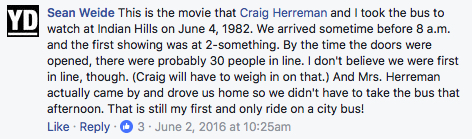
I remember seeing "Star Trek II" at Indian Hills as a kid. Last year, my brother-in-law Sean and I were posting on Facebook about seeing the movie in the theater's old Cinerama auditorium back in 1982:


Unfortunately, my brother-in-law died earlier this year. I felt wistful as I watched Star Trek II yesterday because I knew if Sean was around he would suggest we go see this re-release at Aksarben Cinema.

The 35th anniversary Blu-ray's transfer looks better than it ever has, despite the inherent limitations of films released in the 1980s. It contains both the director's cut and the theatrical version (the additional footage in the extended version primarily focuses on Mr. Scott's nephew Peter Preston, an engineering cadet on the U.S.S. Enterprise).

If you do decide to order this film on Blu-ray, please be aware that Paramount has released an updated version of the "director's cut" on disc (fixing an error involving a line of dialogue by Mr. Sulu in the film). Be sure to check the back of the packaging to see if the movie has a "yellow" UPC barcode -- that is the "corrected" version. 


Fathom Events is bringing this week's screenings of Star Trek II: The Wrath of Khan to theaters around the country. As an added bonus, you get to watch an exclusive interview with William Shatner. (If you don't follow Shatner on Twitter, he is pretty prolific...and funny.)


The chance to see Star Trek II: The Wrath of Khan in a movie theater again provides a terrific opportunity for long-time fans -- along with those unfamiliar with the film -- to experience one of moviedom's benchmark science-fiction adventures on the big screen. 

Several years ago, a writer named Ray Oldenburg wrote a book called The Great Good Place, a book focusing on the notion that everyone needs a "third place" -- those spots in a community "where people can gather, put aside the concerns of work and home, and hang out simply for the pleasures of good company and lively conversation."

When I hear people talk about their fondness for Star Trek II: The Wrath of Khan (including the comments of my brother-in-law above), it serves as a reminder about the power of experiencing a movie in the theater, and how those moments stick with you. 


"Star Trek" fans take note: Star Trek II: The Wrath of Khan director Nicholas Meyer is currently a producer on the upcoming CBS series Star Trek: Discovery, and is rumored to be working on another Star Trek series focusing on the character of Khan. 

Previous post: "Two-Paragraph Tuesday: Right Into The 'Danger Zone'" 

Tuesday, August 29, 2017

Two-Paragraph Tuesday: Right Into The "Danger Zone"


I found one of my old 45 records while I was cleaning my office this afternoon. Back when I was a teenager, I lived in my parents' attic, and the previous owner had constructed a pretty cool audio setup with a turntable, reel-to-reel tape decks, tuner, and 4' x 4' custom-built speakers. As a result, I purchased a number of 45 rpm singles of popular artists — not knowing that the ability to buy vinyl singles at Musicland was soon to end. 

I'd love to see how Kenny Loggins's "Danger Zone" sounds, but Bridget told me last year I couldn't get a record player (even though it totally seems like something I should have in my A/V arsenal). Anyhow, I thought this was a neat find, and it reminded me how much I enjoyed collecting these little vinyl records.

Previous post: "Book Review: 'Ready Player One' — Shall We Play A Game?"  

Sunday, August 27, 2017

Book Review: "Ready Player One" - Shall We Play A Game?


It's an odd thing that the first-ever book review for this blog happens a little over a year into posting. The reason it's odd is because books are a big part of my life. 

I knew after reading the first few pages of Ernest Cline's "Ready Player One" that it would be a fitting first review. Not only is the first-person narrative in this futuristic novel compelling, the story centers around a treasure trove of 1980s pop culture -- crafted with a fanboy's love and affection. 


"Ready Player One" tells the tale of Wade Watts, a teenager in the year 2044 who lives in the Oklahoma City "stacks" (mobile homes and RVs piled high on stilts -- to save on ground space). Wade's mother died from a drug overdose, and he resides with his aunt and her boyfriend. 


Wade doesn't spend much time with his aunt, nor does he spend much time in the real world. Neither does the rest of society. 


As is the case with a number of futuristic dystopian societies in fiction, the planet has basically gone to hell in a handbasket. Earth has been suffering from an energy crisis (the "Global Energy Crisis"), climate change, and a long-standing recession. 


Much of the world spends its time "living" in a multi-player computer game called OASIS (Ontologically Athropocentric Sensory Immersive Simulation). The digital world was created by a software developer named James Halliday, owner of Gregarious Simulation Systems. The immersive enviroment is used by people on a daily basis via OASIS consoles, visors, suits, and gloves. 


OASIS isn't just a digital world, it is a full-blown virtual universe. 


Wade uses his school-issued console, visor, and gloves to participate in the OASIS world via an avatar he has created. He accesses the OASIS in his "hideout" -- an old van in the stacks where he can play in peace. He also attends an OASIS Public School.  


We find out early on in the novel that James Halliday has died. The reclusive creator left a short video message for the world to see. The film -- dubbed "Anorak's Invitation" -- is filled with obscure information from 1980s pop culuture. (Anorak is the name of Halliday's OASIS avatar). 


Viewers learn that Halliday's entire estate (valued at $240 billion) -- along with a controlling share of his company -- is being put in escrow until the conditions of his will are met. 


He has hidden an "Easter egg" somewhere in the OASIS environment ("three keys open three secret gates"), and the individual who finds the hidden egg will inherit Halliday's fortune and control of OASIS. 


Wade is obsessed with the hunt. He nitpicks all the minute details in Anorak's Almanac -- Halliday's personal journal filled with biographical information, random thoughts, and 1980s references. 


As a result, our protagonist binge-watches TV shows like Family Ties, memorizes movies like WarGames, plays classic Atari games like "Adventure," listens to bands like Rush, and uses popular ad slogans like "time to make the doughnuts" (from the famous Dunkin Donuts ad campaign). 


Wade and his fellow "gunters" (a fusion of "egg hunters") spend copious amounts of time obsessing over the Easter egg hunt, and have message boards and digital resources dedicated to the topic. His best friend is an avatar named Aech, a fellow gunter in the virtual world. 


Wade keeps a detailed "grail diary" (a reference to Indiana Jones and the Last Crusade) to store notes on everything he learns in his quest.


Many want to win the fortune. Others merely want to stop the "Sixers" -- the gunter nickname for the employees of Innovative Online Industries (IOI) who are hunting for the Easter egg (they have an established Oology Division dedicated to that purpose). 


IOI is a communications conglomerate that is the globe's largest ISP. They are in the business of "monetizing" the OASIS enviroment (a world that Halliday intended to be open for all), by selling access, goods, and advertising to users. They are the over-reaching corporation in this dystopian world (and the description of the IOI headquarters feels like something out of George Lucas's film THX 1138). 


The head of operations at Innovative Online Industries is Nolan Sorrento (who serves as the main antagonist in the story). 

Using his avatar (named Parzival), Wade soon finds the first key in the challenge. 


Wade seeks Aech's wisdom along the way, and also bonds with fellow gunters Art3mis (a female avatar who is an OASIS crush for Wade) and two Japanese players named Daito and Shoto.


What ensues is a multi-player hunt (sometimes deadly) utilizing pop culture references that will cause "Children of the 80s" to geek out. The future of the OASIS software is at stake -- will it remain an open environment for users, or will IOI and Nolan Sorrento seize control?


For the rest of the novel "it's on like 'Red Dawn.'"

I was born the same year as the author of "Ready Player One," so these references really resonated with me.  


As a kid in the 1980s, I lived for Star Wars, Raiders of the Lost Ark
, Back to the Future, Star Trek II: The Wrath of Khan, Big Trouble in Little China, Tron, and other 1980s sci-fi/fantasy properties. I also sunk way too many quarters into Galaga machines during that era (my favorite video game to this day). 


Readers are treated to mentions of John Hughes teenage angst dramas. Iconic characters like "Max Headroom" and "Johnny Five" (from the movie Short Circuit) make appearances. 


There are OASIS planets with names like Benatar (after the singer Pat Benatar) and Falco (like the Austrian rapper who brought us the song "Rock Me Amadeus").


Various computer and gaming systems of the era are referenced -- like the Atari 2600, Apple IIe, TRS 80, and Commodore 64.

I was hooked early on in "Ready Player One" when I read Wade Watts's login phrase to get into OASIS:


You have been recruited by Star League to defend the Frontier against Xur and the Ko-Dan Armada 


That is a line from the cheesy sci-fi flick "The Last Starfighter," a movie my mom took me to see at the Millard 4 in the summer of 1984. 


The cool thing about Cline's novel is that the 1980s factoids aren't merely "tacked on" for the sake of nostalgia. Rather, those retro nuggets are integral plot points used in solving Halliday's challenge. 


Cline also avoids making this a "cliche" 1980s homage. He doesn't just reference those 80s properties which are still popular today (or those that have become popular in intervening years). 


For example, he mentions TV shows like "Riptide," "Whiz Kids," and "Square Pegs" -- which are TV shows very much off the beaten path. 

Another strength of the Cline's narrative is that he avoids too much heavy-handed commentary on the social ills of his futuristic society. Sure, those points come out in dribs-and-drabs as the story unfolds, but Cline keeps the focus primarily on the hunt, and on the 1980s culture employed. 

"Ready Player One" had a way of transporting me back to my youth -- in a manner I haven't experienced with other novels. By employing so many nostalgic '80s references, Cline was able to stir up an interesting cocktail of emotions in this reader -- feelings that generated an emotional undercurrent that isn't often found in this territory. 


Not only that, the story is structured in such a way that younger readers (who weren't alive during the decade) will want to seek out that era's films, shows, songs, and games to experience them for themselves. 


Next March, "Ready Player One" hits the big screen in a new movie directed by Steven Spielberg. 


A first-look teaser for the Warner Bros. production hit San Diego Comic-Con this summer. The trailer features an orchestration of the score from the 1971 movie "Willy Wonka & the Chocolate Factory" and the song "Tom Sawyer" by Rush. 


There's no doubt that the movie will be different than Cline's novel. However, fans of the book should be heartened by the fact that Cline helped write the screenplay. Fans should also be pleased that the architect of so many enduring '80s cinematic tomes (that Cline loves) is at the helm. 


I'm looking forward to seeing how they adapt the novel, and which 1980s references make it into the feature film. 


My niece Emily first recommended "Ready Player One" to me several months ago. I'm glad I finally took the time to read it. She and her sisters have recommended a number of books I've absolutely loved the past few years.


Also...


I've seen Ernest Cline over the years in various documentaries focusing on 1980s pop culture (if you haven't seen the docs "Atari: Game Over" or "Raiders! The Story of the Greatest Fan Film Ever Made," they are both on Netflix as of this writing).


He also wrote the movie "Fanboys" with Adam F. Goldberg (who is responsible for the wonderful ABC TV series set in the 1980s called "The Goldbergs").


I picked up "Fanboys" on DVD several years ago from the sale bin at Walmart. While that comedy (about a group of friends who want to take their dying compatriot to Skywalker Ranch so he can see "Star Wars: Episode I -- The Phantom Menace") wasn't perfect, it definitely stuck with me. 


I could keep rambling on, but I won't.  


I'm getting ready to order Cline's second novel "Armada," and will try to have a review for you soon!


Previous post: "Best of 'Jon Crunch': Year 1"

Tuesday, August 22, 2017

Best of "Jon Crunch": Year 1


Here's where we're at...

Twelve months. Seventy-one posts. 


Not the output I was hoping for during the first year of the blog, but I think it is a pretty good start. 


There were a number of fun things I experienced in life the past year because of this blog -- things I wouldn't otherwise have tried and written about. 


In honor of the first year, I am going to share with you all the "Top 10" posts this past year (in terms of traffic) on the blog, as well as six additional posts I really liked (which should have had more traffic). 


The Top 10


1. "Envelopening: What Happened to Dean Blais?"  

In my mind, this ranks as one of the least exciting posts of the past 12 months. But, because it was an "unboxing" (well, envelope tearing) video about our UNO Hockey season tickets, we were able to share the post on our MavPuck.com social media channels. 

Dean Blais (who was the head coach of the team last season) wasn't featured in the ticket booklets, even though past players and coaches were included. 


Was that a snub? You'll have to decide for yourself, but it was almost prescient considering how "The Blaiser" was "let go" by the university this past season.


********************************


2. "'Dunkirk' Review: 'There's No Hiding From This Son."

I did a number of movie reviews this past year, and I'd like to thank Aksarben Cinema for sharing this review I did when "Dunkirk" was released -- that really helped the traffic counts for this review. 

I thought it was one of my better reviews, and I think it epitomizes the pattern and style I want to follow for future movie reviews. 

********************************

3. "Utah Trip, Part 1 -- One Guy, Seven Girls, and an RV"

This was a fun trip. This post, the first in a 4-part series, not only ranks as one of the most trafficked posts this past year, but it also one of my favorites.


********************************

4. "A Modern Day Treasure Hunt"  


This was a fun game. It also illustrates the power of social media, and raises questions about safety when it comes to anonymous "string pullers" sending people around the city in search of prizes. Kind of reminded me of the 2016 movie "Nerve."


********************************


5. "Why I Became a Cord Cutter"  


This post just keeps percolating along. I've done a few posts on the topic, and would like to do more posts, because people I talk to are increasingly interested these days in dropping traditional cable and satellite television subscriptions. 


********************************


I was really fond of the "Emerging Terrain" grain silo project, and appreciated the efforts of Anne Trumble and her supporters as they tried to make aging and derelict parts of our city interesting. We need more people starting those sorts of "conversations" within our community. 

********************************


7. "What Is A Pinning Ceremony?" 

The International Baccalaureate program is relatively new in high schools around the United States. My niece Lauren had my write a post on an IB tradition -- the "Pinning Ceremony"...


********************************


Don't hate me... I decided to do a fidget spinner post (at the height of the novelty's popularity) because I knew it would get clicks. But it turns out the post was kind of interesting... 

********************************

9. "'Victoria': Is This Brit Import Worthy of 'Downton Abbey's' Timeslot?" 

There are two British period dramas focusing on the "Royal Family" that I enjoyed this past year (the other is Netflix's "The Crown," which I also reviewed). "Victoria" is a co-production of PBS's Masterpiece label, and Brit broadcaster ITV. 


Not only did I review the first season of "Victoria" in this post, I also outlined how Bridget and I were able to binge watch it on Apple TV via PBS Passport (which is available to PBS donors). 


********************************

10. "Utah Trip, Part 4 -- Stranded, Slurpees, Trolley Square, Burgers, and a Tonka Truck"  


The fourth part of our trip west (for the Tour of Utah) proves that even in the face of a big ol' SNAFU, you can find a way to have fun... 

Bonus Picks

Bonus #1. "I Don't Get Grown-Up Coloring Books" 


I liked this post because it was kind of snarky and biting. It also irritated some of my Facebook friends who are are grown-up coloring book afficionados...

Bonus #2. "The Sightseeing Complication" 


I learned last September that I am prone to having claustrophobic panic attacks in confined, underground rail systems... on humid days. Who knew? 

Bonus #3. "These Kids are 'Sharp...Cheddar Sharp'"


There are some really talented kids making films in Omaha...and my niece Julia is one of them.  

Bonus #4. "'Baby Driver' -- Car Chases, iPods, Blondes and 1990s Cool"


I absolutely loved this movie -- my favorite of the summer. I saw it four times at Aksarben Cinema (and wish that I'd seen it a fifth). I was able to pick out a lot more subtlety and nuance the more I saw the movie, and would have written a much better review after multiple viewings. But this review will give you an idea about why I loved this movie so much. 

Bonus #5. "I've Been Slimed!" 


What's summer without a fun project? My niece Veronica is our family's slime expert. It's pretty cool. I just wish we'd done a "how to" video on making slime. 

Bonus #6. "'We Can Rebuild It. We Have the Technology." 


There's nothing better than crawling up into the attic and running new coaxial cable from a long-forgotten, 1960s-era antenna to receive rock solid HD signals from the local TV affiliates! 

So there you have it!

Missed my most recent blog post? Check it out here: "Eclipse Anomalies Create TV Reception Oddities?"