Friday, July 8, 2022

TV Review: Pratt’s Performance Elevates Visceral “The Terminal List”


By Jon Brooks

“This is Antoine Fuqua meets Alfred Hitchcock...” — Jack Carr recounting showrunner David DiGilio’s description of Amazon Prime Video’s “The Terminal List” 

In early 2018, I started seeing mention on Twitter of a new thriller novel titled “The Terminal List” by an author named Jack Carr (a former Navy SEAL). 

Many of the people I interact with on Twitter were looking forward to Carr’s debut novel. It sounded like something I would be interested in reading. I’ve long been a fan of the thriller genre, and the premise seemed intriguing. 

So I pre-ordered a copy and set my sights on reviewing it. 

When you start a blog — or any sort of creative pursuit — your main hope is that people will enjoy it. Throughout 363 posts (as of this writing), I'm primarily fueled by feedback and interest from readers. 

When I reviewed Carr's “The Terminal List,” I never imagined it would become my most viewed blog post. But as the years have progressed — and as Carr has built a legion of loyal followers — the review steadily rose and has become the top performing post on my blog (read my review). 


In my review, I described the novel as “a story that stings the throat and clears the sinuses — bold, brutal, and unwavering.” 

Carr does a terrific job marketing his books — and his love of pop culture is evident. I am the same age as the author, and grew up with many of the same influences.

My mom and dad took me to the theater to see most of the macho military action movies of that era. I fondly remember seeing movies like “Rambo: First Blood Part II,” “Commando,” “The Delta Force,” and “Invasion U.S.A.,” with my parents at our local multiplexes. 

I was also a fan of the TV series “Magnum, P.I.” as a kid, and remember watching it with my parents on Thursday nights (keen-eyed readers will find several references to the show in Carr’s work). 

My love of mystery and thriller novels began at a young age. I remember loving “The Hardy Boys” series during elementary school, reading WWII-related children’s books like Bernard Glemser’s “Radar Commandos,” and later developed a passion for "grown up thrillers" when a high school literature teacher gave our class the assignment of reading a Tom Clancy or Robert Ludlum novel (I chose Clancy’s “Patriot Games”). 

When news started percolating about a filmed adaptation of “The Terminal List,” I was curious to see how Hollywood would interpret Carr's well-drawn thriller. 


And, when it was announced that Chris Pratt would star in a series adaptation of the novel on Amazon Prime, my initial curiosity transformed into pure excitement. A multi-episode series would allow the filmmakers to dive into the story and explore the characters in a more significant manner. 

“The Terminal List” chronicles the exploits of Lieutenant Commander James Reece (Pratt) here on the home front in Coronando, California, after his SEAL team (operating out of Incirlik Air Base in Turkey) conducts an ill-fated mission in Syria (Operation Odin’s Sword) to eliminate a chemical weapons specialist known as “Chemical Kahani.”  


In the aftermath, Reece questions his recollection of the particulars that transpired during the covert mission, and starts to question his own judgment as the leader of Alpha Team. 

Moreover, when a surviving team member mysteriously dies stateside (of a suspected suicide), Reece believes the cause of death isn’t a cut-and-dry case. 

Is Reece paranoid, or is he on the right track? 

He worries that Kahani is targeting his men, but soon learns there is a greater conspiracy afoot — a conspiracy that puts our protagonist, his wife Lauren (Riley Keough), and daughter Lucy (Arlo Mertz) in extreme danger. 

With the help of intrepid reporter Katie Buranek (Constance Wu), Reece starts to put the pieces together. 


Things are not as they seem, and Reece soon finds himself in the center of a maelstrom that reaches the highest corridors of power. 

Somewhere, somehow, someone is going to pay. 

The eight-episode series manages to imbue the spirit of Carr’s novel, and Pratt (a surprisingly versatile actor) becomes the embodiment of Carr’s protagonist. 


As is the case with many page-to-screen adaptations, there are a number of differences between the book and the movie — far too many to highlight in this review. 

In general, I was fine with the changes made to the story and its various settings. Producer/director Antoine Fuqua (“Olympus Has Fallen,” “The Equalizer”) and showrunner David DiGilio (along with his writing team, who worked on much of the production via Zoom due to the pandemic) do a yeoman’s job navigating these intricacies, and create a compelling narrative for the screen. 

One interesting stylistic choice was the show’s moody production design. 

“The Terminal List” is a dark revenge tale. The production employed a dim, dreary, and desaturated color palette (and lighting scheme) to hammer that point home. 

Characters are often lit in shadow, giving things a “noirish” feel. Some viewers might question the aesthetic. Taken in total, I think the effect largely worked. 


There are also moments in the story where Reece questions his sanity — stylized flashback/hallucination/dream sequences are utilized and allow for additional nuggets in Reece’s backstory, giving the character more texture in the process. 

For me, the highlight episode of the season was the sixth, titled “Transience.” 

I won’t go into any specifics, but I found it to be an entertaining chapter. I’ll simply say that it had sequences that reminded me of the 1982 film “First Blood.”  

(By the way, if you haven’t listened to Jack Carr's podcast interview with “First Blood” scribe David Morrell, it is well worth your time!) 

There are also various “easter eggs” from the novels strewn throughout the eight episodes of “The Terminal List.”  

For example, @Marc_Harris3 on Twitter pointed out a shot in the series where a bottle of honey and a small box of half-and-half sits in front of Reece and his coffee mug: 


Another detail from this book is the inclusion of Reece’s 1988 Toyota FJ62 Land Cruiser. In this video, Carr (a Land Cruiser aficionado) gives us a tour of the actual vehicle used in the series: 


Small details like that illustrate the care the filmmakers put into the series. 

In addition to Pratt — who gives his most nuanced performance to date — there are a number of notable performances in “The Terminal List.”  

In particular, some of the smaller roles stood out to me. 


I really enjoyed Tyner Rushing as pilot and former Army Aviation Branch Warrant Officer Liz Riley. While there wasn’t much meat to the role, the filmmakers did a solid job giving the character some nice morsels as they outlined her background and friendship with Reece. 

Former Navy SEAL Jared Shaw plays Special Warfare Operator First Class Ernest “Boozer” Vickers, a member of Reece’s team. Again, it wasn’t a big role, but the character is memorable. 

Shaw (who also serves as a technical advisor on the show) received a pre-release copy of “The Terminal List” back in 2017, and gave it to Chris Pratt (who optioned it soon thereafter). 

I also enjoyed seeing Jai Courtney in action as antagonist Steve Horn, head of Captstone Industries. He’s familiar with this territory, and I’ve enjoyed the actor’s work since his roles in “Jack Reacher” and “A Good Day to Die Hard.”  


There are also some small cameos of note in the series (including an entertaining appearance by Carr himself in the third episode). I enjoyed seeing former Navy SEAL Remi Adeleke make a brief appearance in “The Terminal List” as well.  

I first became familiar with Adeleke when Bridget ordered me one of his KEJO Wear t-shirts — a design we saw Neil Brown Jr. wearing on an episode of the CBS series “SEAL Team”: 


Overall, I had a good time watching Amazon’s adaptation of “The Terminal List.” The episodes move at a brisk pace, and Pratt’s performance elevates the narrative. 

As a longtime fan of this brand of thriller, I was heartened to see the care and craftsmanship that was put into the eight-episode season. 


There are so many wonderful print properties waiting to be developed. I hope the success of “The Terminal List” paves the way for more of these stories to make it to the screen. 

“The Terminal List” sets a new standard for thriller adaptations. Even if you haven't yet read Carr’s novels, I think you’ll find a lot to like in this series. 

If you want to learn more about “The Terminal List” on Amazon Prime Video, visit the show’s official website here. 

To learn more about author Jack Carr and his novels, visit his website at www.officialjackcarr.com. 


>> If you enjoyed my review of Chris Pratt’s “The Terminal List” series, please follow me on Twitter/X – @TheJonCrunch 

Related posts on Jack Carr: 


Friday, June 10, 2022

“Top Gun: Maverick” MEGA REVIEW


When I consider blockbuster movie sequels over the past 20 years, there are few I have anticipated more than “Top Gun: Maverick,” the follow up to the 1986 hit “Top Gun.”

We’d heard rumblings about a sequel for many, many years. I wasn’t convinced it would ever happen. Sure, Tom Cruise has proven himself to be near immortal as he has pushed the limits of his body — and old school practical effects — in the terrific “Mission: Impossible” franchise. 

I just wasn’t convinced that Hollywood would want to create a franchise from a single film firmly rooted in the 1980s Cold War, Reagan-era pastiche. 

And if they did, I was worried it would lose all of charm the original movie imbued (see 2012’s “Red Dawn” reboot). 

After a three-year wait (the film’s original release date was July 12, 2019), “Top Gun: Maverick” has finally been catapulted into theaters. 


The timing of the film’s release couldn't be better. 

The theatrical box office has taken a hit in the past 24 months. Some have been ready to relegate the movie-going experience to the annals of nostalgia in this so-called “new normal.”

And while there have been some recent blockbusters (like 2021’s “Spider-Man: No Way Home”), you sometimes wonder if Marvel movies (and their ilk) are the only films mass moviegoers care about seeing on the big screen anymore. 


Leave it to Hollywood’s last true movie star to change the narrative. 

“Top Gun: Maverick” recalls a bygone era in the world of summer blockbusters. It is a film that avoids an agenda (thankfully) and reminds viewers how much fun movies can be when you don't need a “cheat sheet” to know what’s going on. 

I’ve already seen the movie twice (my brother-in-law took me for the second time a couple days ago). 

When I was a teenager, I remember eagerly anticipating the summer preview issue of Premiere Magazine. The editors would typically predict how each film would finish at the box office, and it was fun to learn about all the upcoming releases.

During those years, there were relatively few sequels. The summer movie season wasn’t dominated by a single genre (for example, “Forrest Gump" made ~$330 million in the summer of 1994 and finished second that year to “The Lion King”).

When I saw “Top Gun” in 1986, it was with my friend Mike Bartholet at Omaha’s Indian Hills Theater — in an auditorium that seated 810 patrons and featured a huge, wraparound screen that was originally built in 1962 to showcase films in the widescreen Cinerama format. 

It was an amazing experience. I was 13 at the time. You felt like you were in the movie. What teenage boy didn’t want to be one of those buff pilots zipping around the skies in an F-14 Tomcat?

“Top Gun” is the quintessential ’80s movie. It was built for the MTV generation and features one of the best movie soundtracks of the era (at no time in history has a hit soundtrack — and the resulting radio and music video airplay — been more important to a movie’s marketing than it was during those years). 


While “Top Gun: Maverick” certainly pulls on that nostalgia, it also feels effortlessly modern and fresh. 

Cruise collaborated with his screenwriter/director pal Christopher McQuarrie (one of the most fascinating scribes in the movie business) on the script (Ehren Kruger and Eric Warren Singer are also credited). The directing duties were helmed by Joseph Kosinski, who worked with Cruise on the sci-fi flick “Oblivion” and helmed Disney’s underrated “Tron” sequel “Tron: Legacy.” 

“Top Gun: Maverick” finds our titular protagonist Captain Pete “Maverick” Mitchell (Cruise) testing experimental planes (and avoiding promotion) at a naval facility in China Lake, California. As the movie begins, the aircraft he is testing (the “Darkstar” scramjet) has the set goal of reaching a speed of Mach 10. 


But irascible Rear Admiral Chester “Hammer” Cain (Ed Harris) — nicknamed “The Drone Ranger” — wants to shut the program down and shift financing to unmanned aerial vehicle programs. 

Maverick (being Maverick) decides to launch one last flight before the admiral’s arrival. Not only does he reach Mach 10 benchmark, he pushes the needle beyond. The move provokes the ire of Cain, leaving our hero in hot water and his future as a pilot in doubt.  

“The end is inevitable Maverick,” Cain tells Maverick as he scolds him for the stunt. “Your kind is headed for extinction.”

“Maybe so, sir,” replies Maverick, “but not today.”

That exchange pretty much embodies the spirit of “Top Gun: Maverick.” It is also likely why moviegoers over the age of 40 — who comprised 55 percent of the opening weekend box office (according to Variety) — have been singing its praises. 


As much as the first “Top Gun” celebrated youth, “Top Gun: Maverick” celebrates experience and the wisdom gained with age. 

At the behest of friend and former TOPGUN class rival Admiral Tom “Iceman” Kazansky, Maverick is sent to NAS North Island to serve as a TOPGUN instructor for an elite group of pilots assigned a seemingly “impossible mission” (see what I did there) behind enemy lines to bomb an unsanctioned uranium enrichment plant. 


To be honest, the whole thing felt like they were training for the Death Star trench run in “Star Wars: Episode IV — A New Hope,” but I didn’t mind a bit (and I don’t think anyone else in the theater did, either). 

What was nice about having a hook like that in the story is that there was more “meat” (and more at stake) in “Top Gun: Maverick” than there was in the 1986 movie. The creators of the original often mention that it was essentially a “sports” movie — the fighter pilots being the talented athletes. 


The pilots Maverick is tasked with training are likable. Granted, Cruise gets most of the screen time in the movie, but there are some notable performances. 


While much of the focus is on Lieutenant Bradley “Rooster” Bradshaw (Miles Teller), son of Maverick’s friend and RIO Nick “Goose” Bradshaw (Anthony Edwards), some of the other members of the team stand out. 

In particular, Glen Powell’s turn as Lieutenant Jake “Hangman” Seresin was noteworthy. A number of people online have compared Hangman to Iceman in the first movie, but when you analyze the character point-for-point, he actually seems more akin to Maverick. 


Powell is an actor I recognized, but I couldn’t recall what he’d been in before (he played John Glenn in 2016’s “Hidden Figures” and was one of Stallone’s band of mercenaries in “The Expendables 3”). I have a feeling we’ll be seeing more of him in the future. “Top Gun: Maverick” will definitely increase his profile. 

I also enjoyed the team of Lieutenant Natasha “Phoenix” Trace (Monica Barbaro) and Lieutenant Robert “Bob” Floyd (Lewis Pullman). 


As the first female pilot to be featured in a “Top Gun” movie, it was nice to see Barbaro make the most of a fairly limited role. 

It should be noted that Lewis Pullman is the son of actor Bill Pullman. The elder Pullman also flew an F-18 Hornet on a deadly mission as President Thomas Whitmore in the 1996 movie "Independence Day." 


What was nice about the “Bob” character is that he didn’t look like a model who had just jumped out of the pages of a fashion catalog. (I mean, there are already plenty of pretty people in this movie.)

The look of the original “Top Gun” was inspired by the work of Bruce Weber (the photographer behind brands like Calvin Klein, Ralph Lauren, and Abercrombie & Fitch), and presented a more “idealized” view of a military officer. 

In addition to the aviators, Jennifer Connelly plays Penny Benjamin (a character mentioned in passing as being an “admiral’s daughter” Maverick once had a relationship with in the early stages of the original “Top Gun”). 


Penny owns the Hard Deck Bar (where all the pilots hang out) near the base. She is a divorced mom with a teenage daughter. 

(Note: During the movie, a song selected on the jukebox in the bar is number “86,” an homage to the original movie’s year of release.) 

As a love interest, I liked her dynamic with Cruise. As someone who turns 50 this year, I appreciated seeing two actors in their fifties — both incredibly well preserved — rekindle an old romantic relationship. 


It could have been overly melodramatic, but the filmmakers chose to take a light touch with the relationship. As a result, they achieved just the right tone. 

Obviously, the *real* star of any “Top Gun” movie is the mix of amazing flight sequences. Filmed in cooperation with the United States Navy (at a reported price of ~$11,000 per hour), the aerial combat sequences in “Top Gun: Maverick” are gorgeous. 


I love the fact that Cruise is committed to practical effects. We’ve all seen far too many modern movies with CG fighter jets — and those computer-generated images just don’t look or feel real. 

A pilot named Mark Scott — who graduated from a local high school here in the Omaha area — helped film some of the flight sequences featured in “Top Gun: Maverick.” I saw the story profiling Scott (a former Navy air-wing strike operations officer) on a WOWT newscast. He also appears as an extra in one of the movie’s bar scenes. 


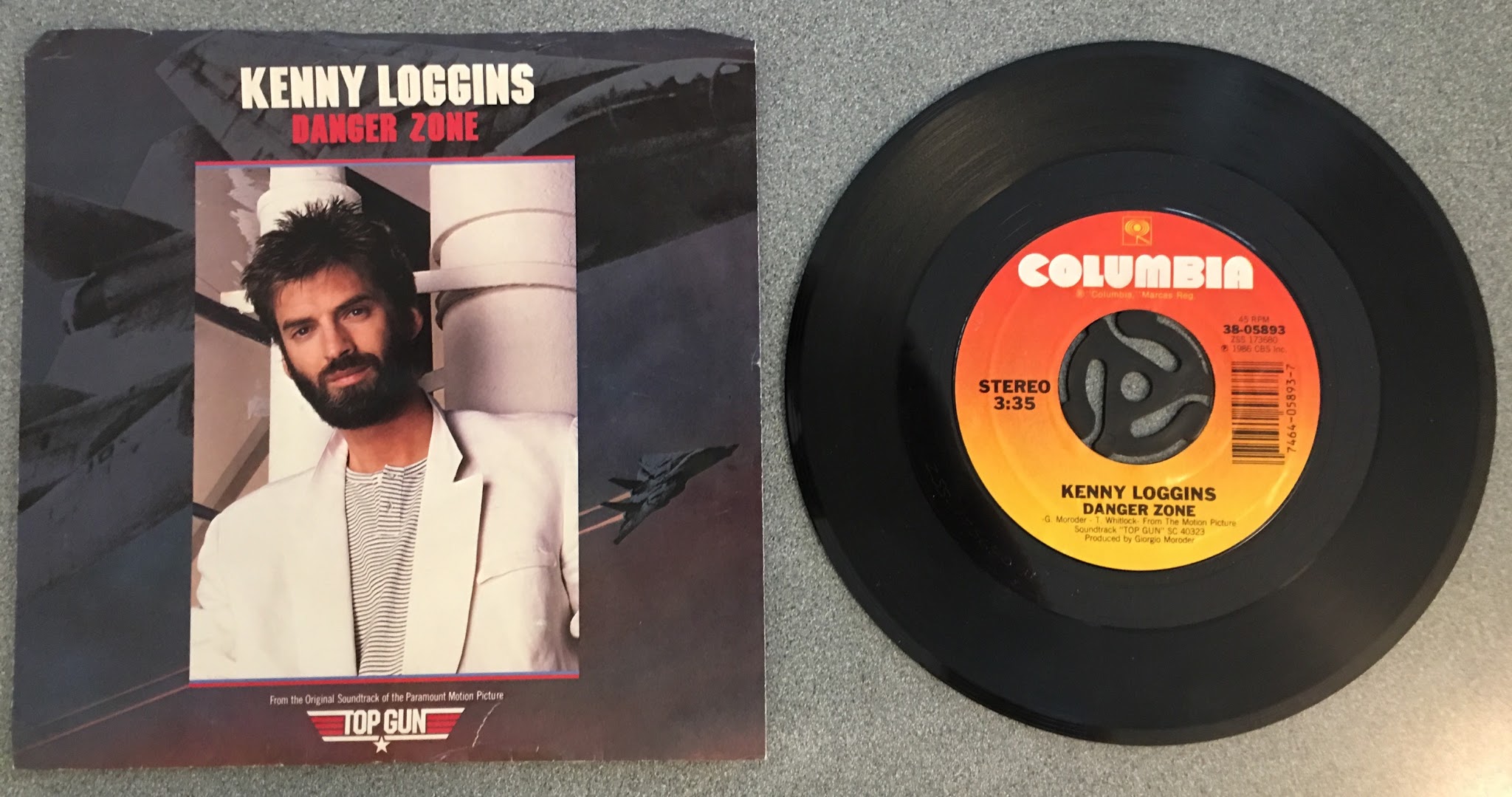
As I mentioned earlier, the first “Top Gun” movie had a terrific soundtrack packed with pop hits. I originally owned the soundtrack on cassette tape and have Kenny Loggins' “Danger Zone” as a 45-rpm single (see picture below). Not long after, I purchased the soundtrack on CD. 


The soundtrack for “Top Gun: Maverick” is geared more toward the instrumental. Harold Faltermeyer’s “Top Gun Anthem” is featured prominently, with additional instrumentals by Lorne Balfe. That said, there are a couple of fresh pop licks by Lady Gaga and OneRepublic this time around.


The standout single (in my opinion) is “I Ain’t Worried” by OneRepublic. The song features a whimsical vibe in the spirit of Kenny Loggins’ “Playing With The Boys” on the original soundtrack (not a surprise since both songs were the backbone of a similar sequence in each movie). Trust me, the tune will be stuck in your head for days: 


There is also Lady Gaga’s “Hold My Hand.” The single (which plays over the movies mid-credit sequence) is power ballad done in the spirit of Aerosmith’s “I Don’t Want to Miss a Thing.” It’s a solid song, but is surprisingly “forgettable” compared to some of her famous hits: 


Overall, I wish they’d been able to craft a few more fresh pop standards for the soundtrack. I know that isn’t the trend today, but songs like Loggins’ “Danger Zone” and Berlin’s “Take My Breath Away” became two of the definitive Top 40 hits of the 1980s. 

As some of you know, Bridget and I are big UNO Maverick Hockey fans. Not only do we run a fansite for the team (mavpuck.com), but we’ve attended each and every home game during the program's 25-year history (crazy, but true). 

In the early years of the program, they played Faltermeyer’s “Top Gun Anthem” and Loggins’ “Danger Zone” (along with audio clips from the movie) during the pregame festivities. 

Sadly, the program shifted away from that over the years, but Coach Mike Gabinet (a former player in the program) pays homage to that tradition with the team’s postgame locker room tradition that awards players “Maverick” and “Goose” flight helmets for a standout performance: 


In addition, the president of the University of Nebraska system is former naval aviator Ted Carter. The Naval Academy grad (who served as superintendent of his alma mater prior to his current stint in Nebraska) was a lieutenant at the Navy Fighter Weapons School (TOPGUN) when the original “Top Gun” was being filmed.

A recent article in the Lincoln Journal Star discusses how Carter was tasked with entertaining Cruise during the movie’s production. Carter told the LJS: “They said ‘Go out and meet Tom Cruise, get him really drunk, and then we’re going to throw him in the swimming pool the next day so we can show him how hard this is.’”

Like Goose in the movie, Carter (call sign “Slapshot” because he played hockey at the Naval Academy) was a RIO (radar intercept officer) in the Navy. The article is worth reading and provides the perspective of a real-life graduate of the Navy Fighter Weapons School (TOPGUN), along with insights into Cruise and the movie. 

Speaking of the Naval Academy, Bridget and I attended a conference in Annapolis, Maryland, in 2016 — our hotel was just up the road from the institution. I purchased this “Maverick” T-shirt at a gift shop near the school: 


The “Top Gun” shirt below came from my brother and sister-in-law. They purchased it for me during a trip to Las Vegas last year. It’s one of my favorites and it was very thoughtful of them to get it for me: 


I’ve worn one of the shirts to each of my two viewings of “Top Gun: Maverick” — it’s obvious I need more themed shirts so I can attend additional showings.😉 

The early success of “Top Gun: Maverick” illustrates that movies driven by star power — and built for U.S.-centric audiences — still work in today’s marketplace. It also shows that “cinematic universes” — where audiences have to watch 20+ movies to understand what is going on — are NOT required to make a compelling movie-going experience. 

It’s also nice to see a movie geared toward a decidedly “older” demographic having box office success. 

At one point in my life, I was attending (at minimum) one movie per week at the theater. The movie-going audience has never been “monolithic.” Movie fandom is a tradition that is passed down from generation to generation, and this is a film that various ages can enjoy together. 


If this movie had been released back in 2019, I’m not sure it would have had nearly the success it is enjoying this year. “Top Gun: Maverick” has seemingly hooked onto something intangible in the current cultural zeitgeist. 

And timing is everything. 

After the global malaise of the past two years, people needed a reason to go back to the movies. They needed to be reminded about why they loved the communal movie-going experience in the first place. 


Movie theaters needed this. Movie fans needed this. The near universal praise of “Top Gun: Maverick” shows the unifying force movies can provide, if done right. 

More than anything, “Top Gun: Maverick” is a fun time at the movies. It doesn’t take itself too seriously. It is a likable movie that reminds viewers what made the theatrical experience exciting in the first place.  

For me, that makes it perfect.


Monday, April 11, 2022

Book Review: “Assassin's Edge” By Ward Larsen


“Fly across the Arctic in winter, violate Russian territory. Maybe go for a dive and blow some things up.” — David Slaton in “Assassin’s Edge”

As I’ve gotten to know the writing of author Ward Larsen over the past few years, I’ve come to appreciate the fact that the author doesn’t write the same book twice. 

His eighth David Slaton thriller — “Assassin’s Edge” — illustrates that point. 

Taken in total with his previous two novels — 2020’s “Assassin’s Strike” (read my review) and 2019’s “Assassin’s Revenge” (read my review) — you see a thriller writer who is willing to mix things up. 

That makes for an enjoyable reading experience. 

“Assassin’s Edge” finds Slaton (a former Mossad “kidon” – assassin) called into duty to find the daughter of former Mossad colleague Anton Bloch.

The disappearance of Bloch’s daughter in Kazakhstan and a downed U.S. RC-135 (known as “Raven 44”) along Russia’s northern border are somehow intertwined. 

Our protagonist has to put these seemingly unrelated puzzle pieces together — in a mission that finds Slaton hopping across the globe as he wrestles past demons and works to thwart a larger geopolitical threat. 

He has to deal with a shadowy operator known as Lazarus, a mysterious cabal known as the Trident, suspicious vessels operating in the open seas, and a whole host of staples familiar in today's espionage thrillers. 

Larsen’s smooth prose and deft handling of multiple plot threads illustrates his skill in the thriller genre. He works diligently to keep an authentic feel in “Assassin’s Edge.”

A former U.S. Air Force fighter pilot, Larsen often gives military aircraft starring roles in his novels. In addition to the RC-135 mentioned earlier, he also features the venerable V-22 Osprey in the narrative (a plane I find fascinating and first learned about in Dale Brown’s 1990 novel “Hammerheads”). 


Larsen dedicates this novel to the late David Hagberg — a thriller writer I first read in 1990 (it was the Kirk McGarvey thriller “Countdown”). Both authors share the same publisher and I decided to pull out Hagberg’s 1995 novel “High Flight” for this occasion: 


While Larsen’s thrillers are current and topical, his stories exude a vibe that would have felt right at home alongside retro-masters like Hagberg, Clancy, Coonts, and Ludlum back in the day. 

If you enjoy espionage thrillers, I’d recommend you check out the novels of Ward Larsen. His books can be read in any order, and “Assassin’s Edge” is a good place to jump in. 

You can order your copy of “Assassin’s Edge” here. 


Wednesday, February 23, 2022

TV Review: Amazon’s “Reacher” Season 1 Gets It Right


“I didn't kill anybody. At least not recently, and not in this town.” — Jack Reacher in “Reacher”

Now this is more like it...  

A little over a decade ago, Bridget and I were eating at our favorite local Omaha Mexican eatery Señor Matias (since closed) when we learned that Tom Cruise would be playing Jack Reacher in a filmed version of Lee Child’s novel “One Shot.” 

We didn’t discover that piece of news while looking at our iPhones. Rather, Bridget and I were munching on some flour tortillas and salsa when a guy at the table behind us exclaimed, “Tom Cruise is not Jack Reacher!”

Tom Cruise doesn’t imbue the physical characteristics — or personality traits — that have made Child’s literary protagonist popular through 26 novels. 

Like many stars of the 1980s, Tom Cruise basically plays himself in most of his movies. 

That said, I really enjoyed 2012’s “Jack Reacher.”

The movie is imminently watchable and crafted to perfection. Much of that success has to do with the partnership between Cruise and writer/director Christopher McQuarrie — a partnership that has yielded “best in class” action movies like the three most recent “Mission: Impossible” films (read my review of “Mission: Impossible - Fallout”). 

Unfortunately, 2016’s “Jack Reacher: Never Go Back” missed the mark (likely due to the fact that McQuarrie wasn’t at the helm). As a result of the film’s lackluster response, the future of the franchise was in doubt. 

Then, a few years ago, Lee Child teased that he wanted to bring the titular character to a “binge series” for streaming. Fans were excited at the prospect. I am one of those fans. 

The first series of Amazon’s Prime Video’s new series “Reacher” is here at last. 

In this production, Jack Reacher is played by relative unknown Alan Ritchson. 


First things first. Ritchson looks like he could eat Tom Cruise as a mid-afternoon snack. He is a physical specimen whose size, stature, and look fit the way the character is described in Child’s novels. 

The 8-episode season is built around Child’s first novel, 1997’s “The Killing Floor.” Well-versed fans of the novels will also note that some of the flashback elements are pulled from the 2004 novel “The Enemy” (read my review) and the short story collection “No Middle Name: The Complete Collected Jack Reacher Short Stories” (read my review). 

While the adaptation paints outside the lines a little bit, it stays pretty faithful to the novel. 

The setup finds our hero — a former military police officer who roams the Earth like Caine in “Kung Fu” — arriving in the small town of Margrave, Georgia. The “Reacher pastiche” in the novels is that he goes wherever the spirit moves him (or wherever a friendly driver is willing to take him). 


Reacher is sitting down in a Margrave diner — ready to eat a piece of peach pie — when authorities arrest him for a murder that took place the night before. 

He is sent to prison with a local banker named Paul Hubble (Marc Bendavid) — a man who is scared of something and falsely confesses to the murder. 

It is such a deceptively simple way to start a story. That’s the genius of Child’s novels. His protagonist — inspired by fictional knight errants of yore — has found himself in the wrong place at the wrong time more times than he probably cares to remember. 

“Reacher” was created by screenwriter/producer Nick Santora. Santora serves as the showrunner and has worked on a number of popular shows like “The Sopranos,” “Prison Break,” “Law & Order,” and “Scorpion.” I recently reviewed Santora’s 2007 legal thriller “Slip & Fall” (read my review). 

Santora does a credible job crafting a series that is loyal to a fault. As the eight episodes rolled along, you could tell that every effort was put into capturing the magic that makes a Reacher novel so special. 

One interesting tidbit: This season of “Reacher” was filmed in Ontario. I Googled to see where it was filmed when I noticed a rack with hockey sticks in a garage during an episode — not a common sight in eastern Georgia. 


In addition to Ritchson, the show is well cast. I particularly liked the interplay between Reacher, police officer Roscoe Conklin (Willa Fitzgerald), and Chief Detective Oscar Finlay (Malcolm Goodwin) as they worked to uncover the bigger conspiracy at play in Margrave. 


The entire dynamic could have been nothing more than a series of heavy-handed, character-archetype clichés and tropes. The show’s writers instead chose to employ a “lighter touch” when it came to characterizations. For that, I am thankful. 


A lot has been made of the fact that Cruise didn’t fit the physical profile of Reacher in the novels. Those who haven’t read the books oftentimes think the criticism is overblown. 

The issue is that Reacher’s physical nature is part of the reason people underestimate his intellect in the novels. His foes assume he is a simpleton — solely based on his appearance. 

That was a key ingredient lacking in the Tom Cruise movies. I mean, Cruise looks like an Ivy League educated attorney in most everything he stars in. 

Alan Ritchson does a good job balancing both attributes of Reacher. I’ll admit, he was a little stiff at times, but that will ease with time. 

More often than not, filmed adaptations of books stray significantly from their source material. We’ve seen it happen time and again in recent years. 

So there was something refreshing about watching an adaptation that tried to hit all the notes. If you look at various reactions to “Reacher” online, viewers seem very pleased with the final product. 

I know I was happy with the first season. I think you will be too. 

Whether or not you are a fan of the novels, I encourage you to check out Amazon Prime Video's “Reacher.” It is a fun action thriller that offers a compelling mystery and interesting characters. 

I’m excited to see where “Reacher” goes from here. The series has already been picked up for a second season. I’m curious to see what book they use as the basis (I’d like to see “Persuader” used — read my review). 

If you enjoyed my review of “Reacher,” follow me on X/Twitter: @TheJonCrunch 


Additional blog posts on author Lee Child and Jack Reacher: