Thursday, April 19, 2018

TV Review: Netflix’s “Lost In Space” a Surprisingly Good Adventure


I guess I never should have doubted. 

I should have gone into Netflix’s new “Lost In Space” series brimming with confidence that the streaming giant could make a compelling, family-friendly drama (the 10-episode season is rated “TV-PG”).

When the first trailer for the series was released back in March, I did a blog post about it. The visuals looked handsome, but I was skeptical. 

Bridget and I spent the past few days charging through the first season of “Lost In Space.” 

Color me impressed. 

“Lost In Space” is an entertaining sci-fi adventure — a well-designed reboot of the 1960s series.


It feels like the writers drew inspiration from films like “The Martian” and “Interstellar” — then wrapped it all in a setting that would make Jules Verne proud. 

At its core, “Lost In Space” is a family drama. The story focuses on the Robinson family — 30 years in the future. They are part of the 24th Colonist Group. 

As fate would have it, a mysterious asteroid referred to as “The Christmas Star” hit Earth. The impact creates serious environmental implications.

Through a series of flashbacks strewn throughout the first season, we see the Robinson family as they are living modified life and dealing with our planet’s changed reality. People have to wear gas masks outdoors. Plant life is in danger. The future of mankind is bleak. 

The Robinsons apply — and are accepted — into the 24th mission to a planet called Alpha Centauri. Humans have begun colonizing that world as a future home for our species. 


The Robinsons are led by matriarch Maureen (Molly Parker). She is an aerospace engineer brimming with excitement about taking her family to a new world. 

She is married to John (Toby Stephens). The combat vet (a former Navy SEAL) has been estranged from the family — spending much of his time overseas on vague military missions. 

The couple has three children. The eldest child (daughter of Maureen, step-daughter of John) is Judy Robinson (Taylor Russell). The 18-year-old is a doctor on the mission — whip smart with a strong moral compass. 


The middle child is Penny (Mina Sundwall), a precocious book nerd who aspires to be a writer. 

The youngest member of the brood is 11-year-old Will (Maxwell Jenkins). He is a kid who likes to build models and has an affinity for geology. 

The first season begins with the Robinson family making a crash landing — on an unknown planet — in a space craft referred to as the “Jupiter.” 


Something has happened to the mother ship (the Resolute) carrying the colonists. As a result, the families have to evacuate in the “Jupiter” pods — and escape through a rip in space. 

The first season finds the Robinsons solving all sorts of scientific puzzles to save their ship, save the other colonists, and save themselves.

On the surface, the premise makes it sound like “Lost In Space” treads fairly predictable territory. 

However, the show’s writers have done a good job crafting cliffhanger moments (literally and figuratively) to amp up the drama. This isn’t a show where the action is built on brute force and fisticuffs.


Rather, this incarnation of “Lost In Space” seems operate by Mark Watney’s line in “The Martian” when the stranded astronaut quips, “In the face of overwhelming odds, I’m left with only one option. I’m going to have to science the sh!t out of this.”

While intellect and problem solving are at the show’s core, it never feels like it is pandering or heavy-handed. 

One of the best aspects of Netflix’s “Lost In Space” is the likable cast. In family dramas like this, it is easy to have a situation where the kids grate on your nerves. 

Thankfully, that doesn’t happen here. 

In addition to the familial aspects of the show, “Lost In Space” features a fairly solid supporting cast. 


Among the other survivors is a low-rent Han Solo-type named Don West (Ignacio Serricchio) — a rougish roughneck who refers to Judy Robinson as “princess” and cynically wants to be paid for his services. 

There has been quite a bit of debate on the web about Parker Posey’s portrayal of Dr. Smith. Her character uses “identity theft” to wiggle onto the mission to Alpha Centauri. She is mentally askew, and schemes her way into the Robinson’s world. 


I didn’t have a problem with the character. Posey does creepy quite well (as evidenced in a scene where she sings “This Little Light of Mine” to herself). 

But, like others on the Internet, I wondered why the Robinsons gave her second chance after second chance... 

One of the more interesting characters in the show is the robot Will discovers in the woods — an alien machine who befriends the boy in similar fashion to the way Scharwezenegger’s T-800 befriended John Connor in “Terminator 2: Judgment Day.”


As I mentioned earlier, the show has strong visuals — a top-notch production design. 

The Jupiter pods are a cross between a flying saucer and a spacious RV (the ships even have “pop outs” to extend the livable space). There is an all-terrain vehicle stored in each of the ships called a “Chariot” — allowing the survivors to move about the mystery planet. 


Also of note is the score by composer Christopher Lennertz. The music featured in “Lost In Space” weaves new orchestrations with John Williams’s original 1960s theme song. Lennertz has composed scores for a number of theatrical movies, and his compositions give heft to the story. 

While the show has its imperfections, “Lost In Space” is a fun adventure. It is a solid sci-fi drama that has a look, feel, and style rivaling many Hollywood blockbusters.

“Lost In Space” solidifies the notion that Netflix has range (and illustrates a willingness to pump money into compelling dramas with family appeal). 


As Don West says, “I don’t believe in looking back; that’s how you crash into things.”

If Netflix wants to win the content wars, it needs to stay on a forward trajectory. “Lost In Space” shows promise, and sets a course for the streaming giant’s future...


Sunday, April 15, 2018

TV Review: “Bosch” Season 4 is Taut Noir Cool


A couple of months ago I had a blog post titled “You Should Be Watching Amazon’s ‘Bosch’." Not only do I believe it is the finest show in Amazon’s Prime Video lineup, I think it is one of the best detective procedurals today. 

Season 4 of “Bosch” debuted on the streaming platform on Thursday, April 12 (earlier than the announced release date of April 13). Bridget and I stayed up until 1 a.m. last night finishing all 10 episodes. 

The latest season doesn’t dissuade my effusive feelings for the show. In fact, the fourth season of “Bosch” might be the best of the series. 

Detective Harry Bosch is back...and on the case. 

This season finds our protagonist investigating the murder of a lawyer named Howard Elias (Clark Johnson) who was prepping for a court case involving brutality claims against the LAPD. 


Elias has a reputation for taking on the department. As such, there is concern that a cop gunned down the unwary attorney on “Angels Flight” — a quaint tram located in the Bunker Hill district of Los Angeles. (This season is based on Michael Connelly’s novel “Angels Flight.”) 

Bosch is put in charge of a task force working to dig up clues and bring the murderer to justice. Their job is made all the more difficult by civil unrest in the community, politics within the police department, and issues in Harry’s personal life. 


What I find so refreshing about “Bosch” is the fact that the show works to “keep it real.” Authenticity is a hallmark of Connelly’s novels. 

In an era where police procedurals have become somewhat lazy as it regards “rapid forensic proof” and “super computers” that churn out ludicrous results, it is nice to have a detective show that deals authentically with the “analog realities” of police investigations. 

Like the previous seasons of “Bosch,” the fourth outing in the series features multiple threads twisting, turning, and ultimately converging into an intricately woven plot that requires thoughtful analysis from the viewer. 


It is wonderful to see a show so deftly work to hook viewers into the investigation. You feel like you’re right there alongside the terse and dogged Bosch as he questions suspects, slogs through boxes of evidence, analyzes security camera footage, and puts shoe leather to pavement in pursuit of the truth. 

At the show’s core is Titus Welliver — a perfectly cast actor who was hand-picked by the author to play the titular character Hieronymus “Harry” Bosch. 

Welliver brings a sensibility to the show that adds to the authenticity. 

Being reliable is the name of the game for each season of “Bosch.” The show is stylish because it is inherently unstylish. This isn’t a tome that relies on fancy transitions or extreme color grading in its execution. 

Instead, “Bosch” goes for the lived-in look, presents Los Angeles as it is, and chooses actors who look like regular people. 


Other standout performances this season include Madison Lintz (as Bosch’s daughter Maddie), Paul Calderon (as the feisty Det. Santiago Robertson), Lance Redick (as Deputy Chief Irvin Irving), and Jamie Hector (as Det. Jerry Edgar). 

But what makes the show such an interesting tapestry is the small roles and supporting players stitched into the various story arcs. 

For example, we gained more insight this season into the “Koreatown Killer” (a thread started in the third season). 

If you haven’t watched “Bosch,” I encourage you to check it out. It is available for Amazon Prime subscribers (for all you videophiles out there, all four seasons of the show are also available to stream in 4K). 

“Bosch” is taut noir cool. 


>> If you enjoyed my review of season 4 of “Bosch,” consider following me on X/Twitter: @TheJonCrunch 

Related “Bosch” posts: 


Wednesday, April 11, 2018

Author Lee Child Reveals the Only Person Jack Reacher is Afraid Of...


The day finally arrived. 

As readers of this blog know, I am a big fan of Lee Child’s Jack Reacher book series. I own all of his published works, and just recently completed reading all books in the author’s repertoire. 

Readers have a friend in the University of Nebraska at Omaha. For the past three years, the university has hosted the Marion Marsh Brown Writers Lecture Series — bringing world-renowned authors to our city for a discussion of their life and work. 

This year’s featured author was Lee Child. 

The event is held at Baxter Arena, which allows the university ample capacity for the event. The tickets are free to the public (a terrific outreach opportunity for the University of Nebraska at Omaha). 

Child was introduced by Dr. Mike Hilt (Interim Dean of the College of Communications, Fine Arts and Media at UNO). My wife and I had Dr. Hilt as a professor years ago when we were journalism majors at the university in the 1990s. Hilt is a top-notch individual — and a fan of Child’s novels. Hilt also conducted a Q&A conversation with the author during the April 11 program. 

Lee Child is an entertaining speaker. I’ve watched a number of his “author talks” on YouTube over the years. 

Child never wanted to be a writer. He wanted to be an entertainer. He dreamed of being part of the Beatles when he was nine (a dream likely shared by a number of kids his age in Britain during that era). 

When Child found himself out of work at 39 (laid off from a job he loved with Granada TV), he decided to try his hand at writing novels. The television network gave him the equivalent of 7 months pay as part of his severance package — so that’s how long he gave himself to write a book. He said he sold the novel with a week to spare. That novel was “Killing Floor” — published in 1997. 


The author is an avid reader. He told the audience at Baxter Arena that he averages reading a book a day (two days if it is a particularly long book). He quipped that when he was a kid in the industrial heart of England, he’d have a book in one pocket, and a knife in the other. 

Child set “Killing Floor” in the United States because it gave his protagonist — Jack Reacher — room to roam. The author emigrated to the United States in 1998. 

Child joked that he did his research on the setting for “Killing Floor” by watching the movie “My Cousin Vinny,” figuring the movie’s Alabama setting was a close enough facsimile for Georgia. 

The author eschews outlines and hard research for his novels, instead preferring to let the creativity flow. “For a writer, your whole life is research,” he says. 

Sept. 1 is the start date for all of Child’s novels. It is a sentimental date for him because it is when he started writing his first novel. He believes in the principle that "the more disciplined you are as a writer, the luckier you get."

(He told our audience that he just finished his manuscript for novel #23 last Thursday).

Child doesn’t believe in protecting his main character. He feels it is a trap that victimizes novelists who write series fiction. As a result, he tries to keep the character of Jack Reacher at an “arms length” distance so readers will like him more.

Child told the audience that there is only one person Jack Reacher is afraid of, and that person is the author himself. 

Lee Child is tall, with fair skin and sandy brown hair — much like his protagonist, only without the bulk. 

He said he’s been asked at events why he’s so thin. He mused that his two favorite food groups are nicotine and caffeine. He estimates he drinks 36 mugs of coffee per day, and keeps three identical drip machines handy so he has a fresh brew ready to go. 

Child has set novels in Nebraska over the course of his 22 published tomes. His novel “Worth Dying For” was set exclusively in the state. He said he was a bit nervous about coming to the state because the “muscle” the bad guys hired in that novel were ex-Nebraska Cornhusker football players. 


The Marion Marsh Brown Writers Lecture Series is sponsored by the Paul Brown family. I have had the unique distinction of doing web design work for some of the businesses their family has been involved with over the years. It think it is terrific that family’s generosity has resulted in this series of author events. 

I’ll be excited to see what author is featured at next year’s event. For what it’s worth, I’d love to see Harlan Coben in Omaha at some point down the road...


Leading up to this event, I filled in the gaps of the Lee Child books I had yet to read. Here are the links to those reviews:


Tuesday, April 10, 2018

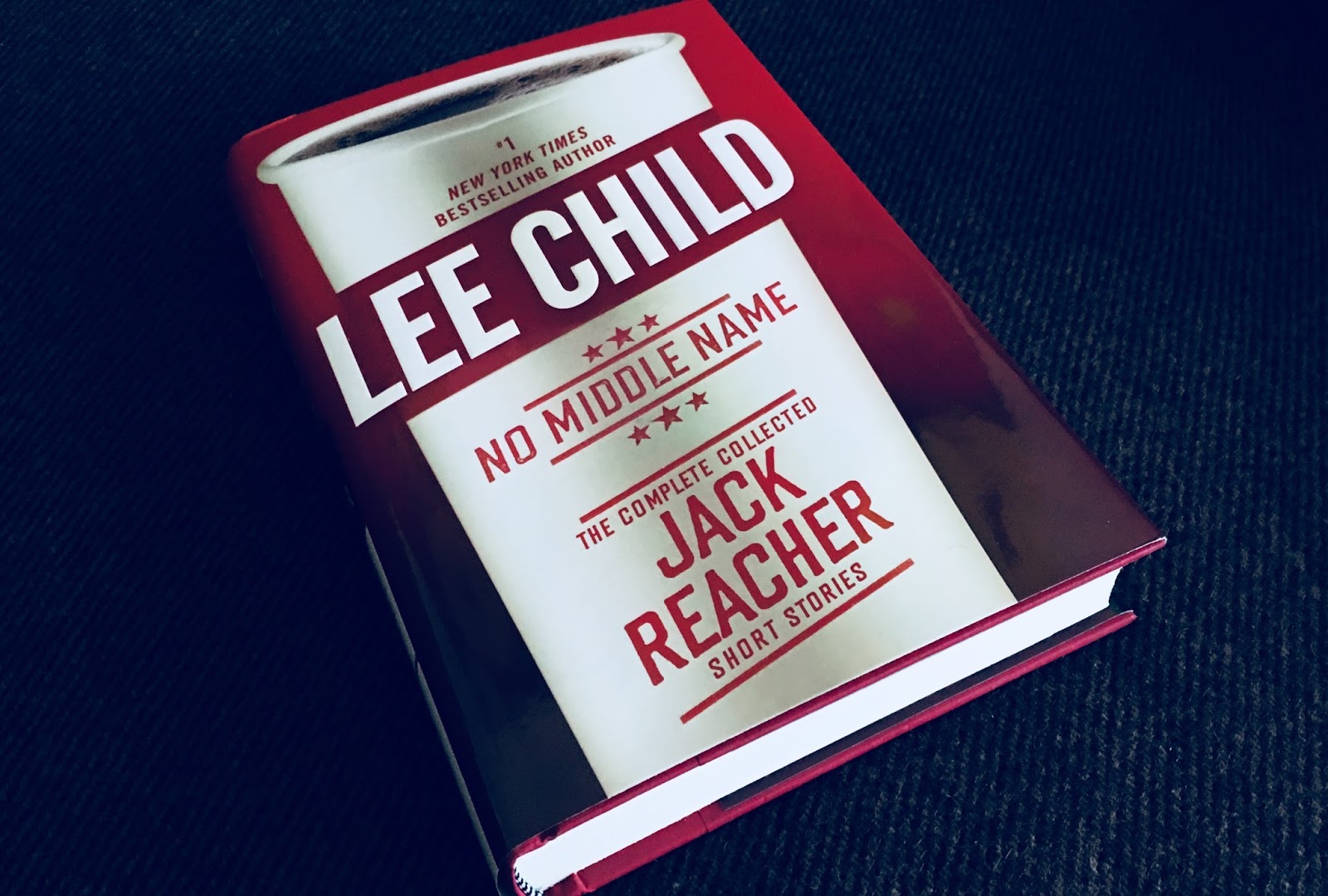
Book Review: “No Middle Name: The Complete Collected Jack Reacher Short Stories”


I made it. I got caught up with all of Lee Child’s published works as of yesterday…about 48 hours before the author is set to speak at the University of Nebraska at Omaha’s Baxter Arena. 

I was running on fumes. I read six of Child’s novels in the past two months. “No Middle Name” capped off the reading marathon. It is a collection featuring 12 short stories by the author. 

I’m not sure of the genesis of every story in the novel. I know that some of them were released as digital exclusives. Others likely appeared in various collections and anthologies over the years.

Short story collections can be something of a mixed bag. This collection is no exception. 

Be that as it may, there are some fun moments in “No Middle Name.”

For me, the most interesting moments came in the stories “Second Son” and “High Heat.” Both tales focus on Child’s protagonist Jack Reacher when he was still a teenager (back in the 1970s). 

“Second Son” finds Reacher living with his family (mom, dad, and brother Joe) on a military base in the Philippines in 1974. “High Heat” finds Reacher wandering the streets of New York City during the 1977 blackout. 

Each story gives us insight into the early days of Jack Reacher — back when he was an Army brat, prior to his time as a military policeman, and before his noble crusade as an unwitting vigilante. 

There is a certain charm in reading stories that take place before the advent of cellphones and computer technology. I think it would be fascinating for Child to craft a full novel focusing on Reacher in that era.

The other two stories in the collection that stood out were “James Penny’s New Identity” and “Not a Drill.” 

In “James Penny’s New Identity,” Reacher is something of a supporting character (when I first started reading it, I wasn’t sure if it involved Reacher at all). The story focuses on a Vietnam veteran (Penny) who finds himself suddenly laid off from his plant job in Laney, California. It is June. Penny suffers from what sounds like PTSD.

Frustrated, Penny burns down his home (a constant reminder of the wife who divorced him) and keeps the only thing that means something to him — a shiny, red Pontiac Firebird. 

He decides to take his severance pay — along with his Firebird — and hit the road. Unfortunately, Laney is located in the Mojave Desert and has a ramshackle volunteer fire department. As a result, Penny’s act of frustration results in fire destroying two of his neighbor’s homes. 

That makes Penny a wanted man, and leads to all sorts of trouble for the disillusioned vet. 

“Not a Drill” finds “present day” Reacher roaming around Maine. He decides to hitchhike his way to the northern end of I-95. Reacher “had a collector’s instinct when it came to places.” Since he had spent much of his life along the Interstate, he wanted to see the northern terminus before Canada. 

When he arrives, he hitches his way back south with two girls and a guy in a decrepit minivan.  The friends are headed to Naismith, Maine — where the forest is untouched by human hands. Two of the crew are planning to spend a few days hiking through a trail in the virgin forest. The other girl (Helen) is set to take the minivan to an adjacent town and pick them up. 

Reacher tags along to Naismith — a small dot on the map with musty cabins, kayak rental on the adjacent lake, and a diner. 

But there is trouble afoot. A mystery lurks in the woods...

As I mentioned earlier, short story collections can be something of a mixed bag. Sometimes the trimmed down tales can feel rushed and unfulfilling. There are a couple of those instances (in my opinion) in “No Middle Name,” but that is a minor quibble. 

There are also two Christmas-based stories in “No Middle Name” (“Maybe They Have a Tradition” and “No Room at the Motel”), and the final story in the collection (“The Picture of the Lonely Diner”) is inspired by Edward Hopper’s painting Nighthawks.

It is a nice feeling to have Lee Child's books crossed off my to do list. There are so many authors I enjoy reading. As time progresses, you find yourself collecting the books, wondering if there is any hope of ever making it through them all. 

As much as you want to gain the bigger picture in a fictional character’s arc — and the arc of a writer’s career — it is the little moments that you live for as a reader. I’m talking about descriptive passages that set the scene and evoke an emotion. 

This is epitomized by a passage in Child’s short story “High Heat.” Reacher heads into a New York City coffee shop, looking for refreshment and an escape from the triple digit temperatures:

“An air conditioner over the coffee shop’s door was running so hard it was trembling and rattling, but it wasn’t making much difference to the temperature of the air. The girls were together in a booth of four, with tall soda glasses full of Coke and melting ice. Two of them were blondes and one was a brunette. All of them had long smooth limbs and perfect white teeth.” 

Those moments are where Lee Child is at his best...


Tomorrow night (April 11) is Lee Child’s appearance at UNO’s Baxter Arena. Expect a full write up this week...!

P.S. — I just noticed there is a new Lee Child digital short story on Amazon (“I Heard a Romantic Story”) published earlier this year. I guess that means I’m not “fully” caught up. I’ll have to catch that story when it shows up in print down the road. 


Sunday, April 8, 2018

New “Solo: A Star Wars Story” Trailer... Chewie Has a Love Interest!


“You might wanna buckle up, baby.” — Lando Calrissian, “Solo: A Star Wars Story” 

From the opening guitar strains on the music accompanying the new trailer for “Solo: A Star Wars Story,” you know this isn’t the same old cinematic territory for the franchise. 

I don’t care what any of the prognosticators think. I don’t care that they had to bring in Opie Cunningham to reshoot most of the movie. 

“Solo: A Star Wars Story” looks legit. 


I was there in 1977 when the first movie came out. I’m not some second-gen SW fan. I know how this has all gone down.  

If you were a kid who grew up in the 1970s and 1980s, you knew that Han Solo was the best thing about the “Star Wars” saga. You didn’t worry about “frozen flying jedis” and “canon purity.”


You were lured into that universe by the roguish smuggler who could charm the pants off a gundark...

I have no idea if “Solo: A Star Wars Story” will be any good. 

Donald Glover (who portrays Lando Calrissian in the film) looks like he just stepped out of an episode of “Troy and Abed in the Morning” — from the genius sitcom “Community.”


That's exactly why I’m stoked to see Glover in the movie. 

While big blockbusters these days are super-obsessed with big, overly sincere, and grave plots about saving all life in the universe, this movie looks like it will be a mindless sci-fi ride. 

That’s what I loved about science fiction movies in the 1980s. The movies back then didn't take themselves so seriously. 

It is curious that Ron Howard plans to premiere “Solo: A Star Wars Story” at the Cannes Film Festival next month. That doesn’t mean it is high art (both “Star Wars: Attack of the Clones” and “Star Wars: Revenge of the Sith” screened at Cannes), but it is a sign that the movie is better than all the “mouth breathers” are suggesting. 


Plus, for the first time since 1978’s “Star Wars Holiday Special” (which I watched on our family's 17-inch Quasar TV set), we’ll get to see Chewbacca with a lady Wookiee. One can only hope that means we’ll also get to see Boba Fett in the film.

May 25th...be there. 

Friday, April 6, 2018

MercyMe Concert... and My Lifelong Love of Christian Music


I’ve had this blog roughly 18 months now, and one thing I haven’t really discussed in any sort of depth is music. 

Most people have certain musical genres they enjoy. Those genres can give the world a sneak peek into who you are. No matter what type you favor, music can give insight into the soul — and transport you back to a time and place that other art forms simply can’t match.

I’ll admit I have eclectic musical tastes. I grew up as part of the “Star Wars Generation” in the late 70s and early 80s. As a result, I love the classical stylings of John Williams and his contemporaries. I wore out many cassettes listening to movie soundtracks as a kid. 

I also enjoy pop, rock, R&B, country, and a whole host of other genres. I’m the person in the buffet line that chooses a little of this, and a little of that. 

The one genre that has been the most prevalent in my life is “contemporary Christian music.” I don’t know if they even use that label for it anymore. But that’s what it was called in my youth. I even had a subscription to CCM Magazine (which stood for Contemporary Christian Music Magazine) back in the 1980s — it is like Rolling Stone for Christian music fans. 

My brother got me into the music. He worked for a large Christian bookstore chain for many years — from part-time employee to handling advertising at the corporate headquarters. The first album he gave me was “Meltdown” by an artist named Steve Taylor. The second was Amy Grant’s “Unguarded” album. 

The first concert I saw was Amy Grant. It was 1985 at the Nebraska State Fair. 

Over the years I have seen many Christian artists in concert. Dozens of shows. I have experienced the creativity these artists have to offer in massive arena productions, and I have listened to these artists perform intimate acoustic sets in church sanctuaries.  

To understand how my wife Bridget and I ended up together in 1990, you have to understand our love of Christian music. It was one of the shared interests we had at that young age. Something out of the norm for teenagers at the time. It was how I knew the girl was someone I wanted to spend my time with... 

As a result, it is a special occasion when we have the opportunity to see one of our favorite artists live. 

We had one of those opportunities last night when we got to see MercyMe (with guests Tenth Avenue North and Tim Timmons) at Baxter Arena as part of the "Lifer" tour.

It is the third concert we have seen at our favorite hockey arena (since Baxter Arena opened in 2015). The previous shows were Newsboys (another favorite Christian artist) and Boston (a terrific guitar-laden-70s-era rock show). 

We’ve seen MercyMe in concert four times. The last time was several years ago in Council Bluffs at the Mid America Center.

The band’s mix of uptempo pop songs and power ballads have proven a popular combination in Christian music. Their breakthrough hit was the introspective ballad “I Can Only Imagine” — which is said to be the bestselling Christian song of all time. 

Hard to believe that song was released almost two decades ago. Many of my friends have seen the new movie about MercyMe founder Bart Millard called “I Can Only Imagine” (I have yet to see the film, but expect a full review on this blog when I do). 


MercyMe’s show at Baxter Arena was enjoyable. The set featured a mix of new and old songs. I will admit that I haven’t followed MercyMe as closely as I did in the early 2000s. My favorite songs come from the band’s first four studio albums. Those songs — which are still favorites today — were largely addressed in a retrospective medley during the show. 

The group’s encore number was “I Can Only Imagine” — a staple at all the MercyMe shows I’ve attended. Here is a video I took of that song's performance: 


Opening acts Tim Timmons and Tenth Avenue North were also fun. I wasn’t familiar with Tim Timmons, but I’ve heard a number of Tenth Avenue North songs on K-LOVE and KGBI. 

Timmons — along with his acoustic guitar — played a set of songs to open things up. 

Tenth Avenue North lead singer Mike Donehey was born in Omaha. He was the most energetic performer of the night — walking out into the crowd, posing for selfies, and walking precariously along the covered hockey dasher boards in the arena. 


(That's him standing on a seat in the middle of the crowd in the above photo.)

Donehey talked about how the band had to scale back a few years ago as family took priority in their lives. Tenth Avenue North reduced the amount of time they toured — which meant less revenue coming into the operation. As a result, he wasn’t sure if the band would survive. 

Donehey expressed his gratitude that the band has continued to make ends meet. His gratitude was evident in the band’s fun, interactive pop set that had the audience moving. 

Depending on the artist, the “shelf life” for contemporary Christian songs isn’t always as long as their secular counterparts. Which means concerts aren’t necessarily “greatest hit retrospectives” — such as the Garth Brooks and Bon Jovi concerts I’ve attended. Instead, Christian acts often focus on more recent hits. 

If you haven’t been to a Christian concert, it is a unique experience. In addition to the music, you will typically hear testimony from the artists, and there will often be speakers from groups like Compassion International and World Vision (child sponsorship ministries working to hook pledges for charitable work in Third World nations). 

Many of these artists started off in churches — some as youth or worship pastors. As a result, the feel of a show is sometimes more akin to a church service at the more modern churches. Videoboards will typically feature lyrics, so attendees unfamiliar with the tunes can sing along.

It is definitely a unique vibe. 

Over the past three decades I have put together a collection of around 300 albums by various Christian artists. Some of the artists continue on today. Others have become mere footnotes in history. 

One thing remains constant. The music is filled with messages of hope, pain, loss, understanding, and redemption. Many of these songs have been important to me during my life.

While Christian music might be a genre that sits off the beaten path, it is part of my path... an important accompaniment to have had along the way... 


Sunday, April 1, 2018

Book Review: “The Midnight Line” By Lee Child


I’m getting close. I’ve almost read every published work by Lee Child. 

“The Midnight Line” is the final novel in Child’s Jack Reacher series that I had yet to complete. It is also his newest (he's published 22 Reacher novels in total). 

The only work I have yet to read is “No Middle Name,” which is a short story collection by the author. I'll be checking it out shortly. 


Not that being all caught up is a requirement. I’ve attended a number of author events without being up-to-date on their entire catalog. But I always feel like I haven’t done my homework in those instances. 

This time, I decided things would be different. I figured the looming deadline of Lee Child’s appearance would be solid motivation to plow through the unread novels. More a personal goal than anything else. 

“The Midnight Line” finds Jack Reacher on a bus, headed out of Milwaukee. As is the case with Reacher, he is traveling to “destination unknown” — going wherever the spirit moves him. 

During a comfort stop in Wisconsin, Reacher happens upon a pawn shop. He sees a 2005 West Point class ring in the window — with a black stone... a small ring in diameter.

His curiosity is piqued. Reacher himself is a graduate of West Point, and his intuition tells him that the commitment and sacrifice that goes into attending a service academy isn’t something you take lightly. He can’t shed his former life as a military police officer, and wonders why the ring ended up in hock. 

Reacher questions the pawn shop owner, who directs him to a man at a biker bar named Jimmy Rat. Jimmy and his crew bring in items to sell from South Dakota (via Minnesota). They never move enough merchandise to draw the attention of the Feds. 

Reacher learns from Rat (through our protagonist’s trademark brand of fisticuff persuasion) that their supplier is a man named Arthur Scorpio. Scorpio is a small-time crook who works out of a laundromat in Rapid City, South Dakota. 

Our vigilant hero can’t let go of the burr in his brain. So he hitchhikes his way across the highways and byways to find Scorpio, and see if he can dig up more information on the ring’s original owner. 

In Rapid City, Reacher meets a police detective named Gloria Nakamura. She is surveilling and investigating Scorpio. He also stumbles upon an Illinois P.I. — who drives a black Toyota Land Cruiser — who is showing an interest in the shady laundromat owner.

Reacher eventually gets an audience with Arthur Scorpio, and information gleaned leads him to Mule Crossing, Wyoming. That is where Reacher starts peeling away layers in his investigation, and where the main narrative in “The Midnight Line” takes place...

(I visted Wyoming last summer, and this pic I took just feels like something from a Jack Reacher book...)


The novel itself has an interesting setup, and Child is at home writing about wide-open spaces in the American landscape. 

Child typically treats socio-political issues with kid gloves in his novels. That said, the author diverts from that a bit in “The Midnight Line,” and takes on a very topical crisis impacting the health of millions in the United States today. 

As is the case with any Reacher story, there are some good nuggets throughout. The character loves greasy spoons, and it is mentioned that Reacher’s go-to breakfast is “coffee plus a short stack of pancakes with eggs, bacon, and maple syrup.”

The novel itself works. Child has a knack for mixing things up from book to book. While “The Midnight Line” lacks some of the nail-biting scenes found in the author’s best work, it is an interesting tale. 

Reacher has never been a particularly introspective or wistful character, but his hunt for the owner of the abandoned class ring shows another dimension of the man. As Det. Nakamura says of Reacher, it is “a matter of military honor. Like a moral obligation. Verging on the sentimental...”

Reacher’s motivation in “The Midnight Line” is perfectly summed up by something a truck driver tells him on his journey across South Dakota:

“My wife would say you feel guilty about something. She reads books. She thinks about things.” 


If you’d like to see Lee Child at UNO on April 11th, you can visit this link to learn more details about the event, and find ticket information. The event is free.