Saturday, March 14, 2020

Review: “Mythic Quest” Season 1 Levels Up The Fun (Apple TV+ Series)


“We’re in the middle of a shovel crisis.” 
Ian Grimm in “Mythic Quest: Raven’s Banquet” 

If you’d told me a month ago that “Mythic Quest: Raven’s Banquet” would be the show that would motivate me to subscribe to Apple TV+, I would have said you were crazy. 

Welp, here’s to the crazy ones… 

When Apple announced they were entering the streaming fray with Apple TV+, I wrote a blog post with my thoughts, titled “Is Apple Too Late?” where I discussed the service. That was almost a year ago. 

In that review, I wrote “I’m wary” as it regarded Apple’s foray into subscription services (which also includes a beefed up news offering, a video game arcade, and the company’s branded credit card). 

Because Apple TV+ is focused on “originals only” (something the marketing team has tried to pimp as a virtue), I was skeptical about whether they’d be able to develop enough compelling programming to keep subscribers interested.


I’m still skeptical (based on the current lineup), but Apple has a winner in the new workplace comedy “Mythic Quest: Raven’s Banquet.” 

The series focuses on a fictitious video game development company with the “highest grossing multiplayer role-playing game of all time” (called Mythic Quest… obviously!). The game is played in 20 countries on six continents. 

As the first season begins, the team is getting ready to launch Raven’s Banquet — an expansion pack for the game. 


Before I go any further, I should note that you DO NOT have to be a “game geek” to enjoy the series. I haven’t played video games since I parted with my PS2 several years ago, and haven’t delved into the current generation of games at all. 

The joy of the nine-episode first season lies in the quirky characters and dysfunctional workplace dynamic seen in the show. It’s all done with a light touch and the show has some genuinely funny moments. 

The tone of the show is sort of a whisked-together mix of the NBC show “Community,” HBO’s “Silicon Valley,” and the 1999 movie “Office Space.” 


The ringleader of the “Mythic Quest” team is Ian Grimm (Rob McElhenney) — a creative director who exudes an oddly charming “God complex” as he perpetually pushes his vision for the game. McElhenney imbues a sort of an everyman Ryan Reynolds vibe. (Bridget called him a “poor man’s Ryan Reynolds.”)

As Grimm tries to navigate the ever-changing world of the game, he’ll use pithy phrases like “just let me noodle” to describe his creative process. 

The game’s lead engineer is Poppy Li (Charlotte Nicdao) — a plucky hipster who serves as a foil to some of Grimm’s more grandiose plans (the interplay between Li and Grimm is one of the show’s strengths). 


The executive producer of the game is David Brittlesbee (David Hornsby) — a Ms. Pac-Man-loving, straight-arrow manager who sports a ’stache that looks like it jumped out of an 80s detective show. 


The head of monetization is Brad Bakshi (Danny Pudi) — an aloof bean counter concerned about maximizing the game’s revenue potential. One of his contributions to the game is the MQ Grand Casino (referred to as “an artless money grab that has no connection to the game”). 


(I loved Pudi as Abed Nadir on “Community”… ).

The main slate of characters is rounded out by C.W. Longbottom (F. Murray Abraham). Longbottom is a washed-up science fiction writer (winner of the 1973 Nebula Award) who builds the narrative structure for the game. Ian met him at a state fair where he (Longbottom) was selling rotisserie chicken. 


(A look at the character’s bookshelf in the second episode shows his bibliography of novels — including one called “Dances With Elves”). 

Highlight episodes for me were Episode 3 (“Dinner Party”) and Episode 5 (“A Dark Quiet Death”). 

The third episode had me chuckling in quite a few spots. It was definitely a novel take on crisis management in a 21st century tech company. Since we provide PR services in our business, we could sympathize with “Mythic Quest’s” trod-upon community relations expert Sue (Caitlin McGee). 

A number of fans online have talked about how good the fifth episode is, and I wholeheartedly agree with that sentiment. 

It is a tonal/narrative shift from the other eight episodes in the first season, and features “New Girl’s” Jake Johnson as the developer of a video game called Dark Quiet Death. The episode builds an emotional core for the first season, and illustrates the melancholy side of partnerships in business. It’s a really terrific story. 

The series was created by “It’s Always Sunny in Philadelphia” writers Rob McElhenney, Charlie Day, and Megan Ganz. 


My friend Jason Combs recommended “Mythic Quest: Raven’s Banquet” to me shortly after it dropped on Apple TV+, and I’m glad I checked it out. 

There were a number of interesting supporting characters in the first season. Game testers Rachel (Ashly Burch) and Dana (Imani Hakim) added dimension to the series. David Brittlebee’s assistant (and the company’s newest employee) Jo (Jessie Ennis) provides moments of levity as a slightly unhinged fan girl of Ian Grimm. Snarky programmer Michelle (Aparna Nancherla) adds… well… snark. 


The show manages to poke fun at the trappings of millennial life as it regards the so-called “influencers” in pop culture. Many of these moments are played out via a 14-year-old gamer known as “Pootie_Shoe” (Elisha Henig) — a live streamer with over 10 million followers who can determine the success (or failure) of a video game with one flippant comment.


I also want to mention how much I enjoyed some of the fun cut scenes and interstitials that were included in the structure of the show. Video game maker Ubisoft is one of the series producers. 


Bridget and I breezed through the first nine episodes of “Mythic Quest: Raven’s Banquet” in a couple days. The first two episodes are available for free (without a subscription) on Apple TV (via the website or the app) if you’d like to check it out for yourself. 


It can be a crapshoot recommending comedies since it is a genre that appeals to specific tastes. I’ve had an affection for workplace comedies like “Community,” “Parks & Rec,” and “Superstore” for quite some time, so this show was right up my alley. 

We had a good time watching the first season. It was irreverent, charming, and a lot of fun. With all the craziness going on in the world right now, I think you’ll enjoy escaping into “Mythic Quest: Raven’s Banquet” too. 


Wednesday, March 11, 2020

Review: “Star Trek: Picard” Season 1, Episode 7 (CBS All Access Series)


“They seem to be carrying more baggage than all of you ever did.” 
Jean-Luc Picard to Will Riker in “Nepenthe” 

The seventh episode of “Star Trek: Picard” (titled “Nepenthe”) manages to nurse the first season back to a healthy path. 

Sometimes a dose of familiar faces from the past is the best remedy in these situations. 

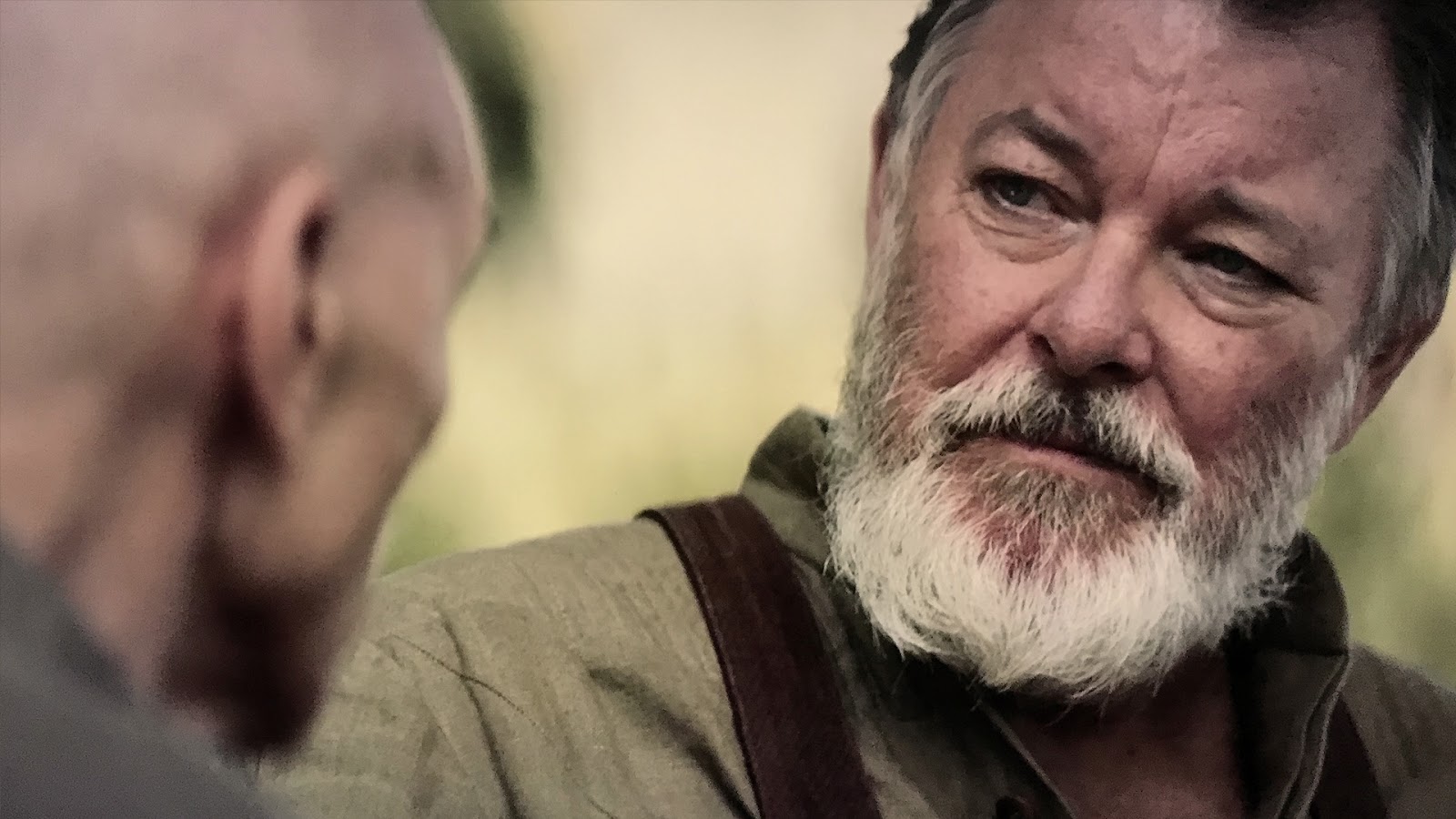
This episode sees Picard (Patrick Stewart) and Soji (Isa Briones) transporting to the planet of Nepenthe — the current residence of William Riker (Jonathan Frakes) and Deanna Troi (Marina Sirtis). The two characters tied the knot in the 2002 film “Star Trek: Nemesis” and were part of Picard’s venerable crew on the U.S.S. Enterprise.  


Riker and Troi have a precocious pre-teen daughter named Kestra (Lulu Wilson). She greets Picard and Soji as they are traversing the wilderness toward the family home. She is wearing a tribal-looking costume and is brandishing a bow and arrow when she surprises the pair as they beam in.

Bridget commented on how much she liked the Kestra character as the episode progressed. 

I also liked the character and thought the entire family dynamic was nice. I think their interaction benefits from how well drawn Riker and Troi were in “Star Trek: The Next Generation.” 


Their presence is (in my opinion) why this episode is so successful. Honorable characters, well drawn, are so much more interesting than edgy characters who are merely there to serve the plot. 

All too often, edgy becomes synonymous with “compelling drama” in the 21st century (or the 24th century, for that matter). 

Part of the reason I’ve shifted back-and-forth with my feelings regarding “Star Trek: Picard” is that the “textured” nature of the new characters sometimes feels overly manufactured — a plot device designed to appeal to modern tastes. 

While I understand the desire to stay on par with your contemporaries, I also know that “Star Trek” hasn’t enjoyed popularity over 50-plus years for following the herd. 

In addition to the storyline involving Riker’s brood, we learn that Romulan warrior Elnor did indeed survive recent events on the Artifact (which took place at the end of the sixth episode).


We also learn more about Dr. Jurati’s (Alison Pill) conversation with Commodore Oh (Tamlyn Tomita) at the Daystrom Institute (which was teased in the third episode). 

Despite the fact that those threads were also going on, the core of the “Nepenthe” episode was Picard and Soji’s interactions with Troi, Riker, and Kestra.


There’s something oddly comforting about watching William Riker make wood-fired pizza (topped with Antarean basil, fresh tomatoes, and bunnicorn sausage) in an outdoor oven.  

“Soji,” says Riker as he is serving the pizza for dinner. “Welcome to our home. Guests get two (slices).” 


Riker and Troi planted roots on Nepenthe because their late son Thad was suffering from a silicone-based ailment, and the soil on the planet was known for its regenerative properties. 

(We also learn that an “active positronic matrix” could have helped cure the disease, but due to the ban on synthetic life, there wasn’t one available. This tidbit in the script felt a tad bit forced and convenient under the circumstances, but I’ll let it pass in this instance.)


It was neat to see the family living a rural life away from the futuristic cacophony of starships and uniform jumpsuits. I particularly liked how their son had a creative bent during his life and developed numerous pretend languages (among them, Viveen) and a fantasy home world (Ardani). 

To be honest, I would watch a show called “Star Trek: Riker.” Think about how interesting a series could have been where Riker & Co. scoured the galaxy looking for an android to help cure his son’s life-threatening illness. 

Bridget agreed. She mused: “Why couldn’t the show have been this from the beginning?” 

Why, indeed. 


Obviously, the side trip to Nepenthe was a moment of fan service, but it was a worthwhile one. It reminds you that the success of TNG was built on the “ensemble chemistry” the cast developed over seven seasons. 

It also reminds you that few new characters on “Picard” (other than Soji and Dahj Asha) are particularly compelling at this point in the show’s development. 


If nothing else, the episode illustrates that the kinder and gentler elements “Star Trek” has embued for decades can still make for compelling drama in the year 2020. 

==============================


Wednesday, March 4, 2020

Review: “Star Trek: Picard” Season 1, Episode 6 (CBS All Access Series)


“I believe she’s close to discovering who she really is...”
Jean-Luc Picard in “The Impossible Box”

SPOILERS AHEAD!

Here we are… the sixth episode. We’re on the downward slide of the first season of “Star Trek: Picard.” 

The episode is titled “The Impossible Box.” 

In this episode, we start to see the narrative move forward a bit. Not a lot, but a bit. 

Soji Asha (Isa Briones) learns she isn’t real. The initial clue is that she makes phone calls to her mother each night that last exactly 70 seconds. Digging further, she soon starts analyzing all her family photos, childhood drawings, etc. 


All of those items are exactly 37 months old, suggesting her life is a fabrication. 

This episode also sees her betrayed by Romulan love interest Narek (Harry Treadaway). He has been working undercover since the first episode to figure out her origin (Spoiler: she comes from a planet with two red moons that has electrical storms.)


Picard (Patrick Stewart) finally arrives at the Artifact and meets up with former Borg Hugh (Jonathan Del Arco). We get a little exposition (early in the episode) about Picard’s past experiences with the Borg (including his assimilation).

An unexpected moment in the episode finds Dr. Agnes Jurati (Alison Pill) and Captain Cristobal Rios (Santiago Cabrera) kissing (apparently they’ve become romantically inclined since the last episode). 


I don’t see them as a potential couple at all, and I’m not sure why the writers decided to have a romantic interlude. Whatever the outcome, this story arc feels rushed. 

We apparently spent a significant chunk of episode 4 convincing the warrior Elnor (Evan Evangora) to come along on Picard’s mission just so he could sacrifice himself at the end of episode 6. 


We might see him again, but he (apparently) makes the ultimate sacrifice so Picard and Soji can escape from the clutches of the Tal Shiar on the Artifact.

If this is the end, it seems like an unceremonious exit. 

I feel like all of this is leading to a point where we discover that the android Data (Brent Spiner) is still alive. If so, it feels like we’ve invested a lot of time and money to make what is essentially a sequel to 2002’s “Star Trek: Nemesis.” 

I was listening to “The John Campea Show” a few days ago, and Robert Meyer Burnett had some thoughts on “Star Trek: Picard.” 

Burnett edited, wrote, and produced all the special features for the Blu-ray release of “Star Trek: The Next Generation” series boxed set. 

Burnett has been tepid regarding “Star Trek: Picard,” and questions whether it is the forward-thinking vision the franchise needs.  


“It’s so steeped in ‘Star Trek’ lore… I mean, you’ve got ‘7 of 9,’ and you’ve got the Borg, and you’ve got Hugh,” said Burnett. “If you’ve never watched ‘Star Trek’ before, ‘Picard’ is not a great place for you to jump on — because it’s so locked into what’s come before.” 

I tend to agree. 

What made “Star Trek: The Next Generation” compelling when it debuted in 1987 was that you didn’t need to have watched a previous episode or movie in the franchise to understand what was going on. Sure, there were nods to the original series, but it was far enough in the future that it was its own living thing. 


So far, I feel like the first season of “Star Trek: Picard” is an interesting idea that could have been executed better. From a story perspective, it seems like the entire thing could have been a two-hour movie instead of a multi-episode series. 

We’ll see what happens in the final four episodes of this season. Maybe I’ll be eating my words by the end… ;-)

==============================


Saturday, February 29, 2020

Movie Review: “The Call of the Wild”


There are some movies that employ computer-generated graphics in an effective manner. 

There are other movies that use computer-generated graphics to the point of distraction. 

The new movie adaptation of Jack London’s 1903 novel “The Call of the Wild” is firmly in the latter camp. 

The filmmakers behind “The Call of the Wild” opted to forgo real-life animals in the movie, and instead crafted all of the animals — including the dog named Buck — in the computer. 


We’ve seen some terrific computer-generated animals in recent years, but they’re best utilized in small doses. Care needs to be taken to assure they feel credible. 

“The Call of the Wild” was released by Disney. However, the film was acquired from 20th Century Fox when Disney purchased the studio last year. 

I have a feeling “The Call of the Wild" would have been better if Disney had helmed the movie during its production. 

The reason I say this is that we have an example of a period drama involving a Siberian Husky pup named “Togo” that debuted on Disney+ last December. That movie (which I will be reviewing soon) does a wonderful job combining real-life dogs with CG elements. 

I’m going to harp on the CG elements in “The Call of the Wild” because they were pretty distracting, and the dogs just didn’t look real. 

The computer-generated animals took me out of the story. 


Speaking of the story, “The Call of the Wild” follows the exploits of Buck, a St. Bernard/Scotch Collie mix who inadvertently finds himself living a life of adventure. 

The movie takes place during the 19th century and the early moments find Buck living in California with Judge Miller (Bradley Whitford). 


Buck is abducted from his genteel life and sent to the Yukon Territory. Upon arrival, he is purchased by a man named Perreault (Omar Sy) and his assistant Francoise (Cara Gee). 

The pair delivers mail throughout the Yukon via dog sled. 


The sequences involving Buck with the dog sled team reminded me of the movie “Togo.” However, none of the scenes in “Call of the Wild” ever felt particularly authentic. That fact made it hard to willfully suspend disbelief. 


Anyhow, the gig with the dog sled team doesn’t last for long because Perreault and Francoise learn that their mail delivery route is being cancelled. The reason mentioned is that telegraph lines are being built in the area. 

(Why telegraph lines would supplant mail is beyond me. I have to believe mail was still delivered to and from the Yukon during that era, but whatever… )

Buck is soon sold to a wealthy man named Hal (“Downton Abbey’s” Dan Stevens) whose only emotion seems to be severe cruelty. (I’m surprised he didn’t spend his time twirling his mustache.) Hal runs the team nearly to death in his quest to find gold (the film takes place during the Klondike Gold Rush). 

I feel like there might have been more to this subplot. One of Hal’s companions is played by actress Karen Gillan, who is a fairly high profile star to get relegated to a bit part. 

I guess I should mention that a kind man named John Thornton (Harrison Ford) encounters Buck during the early stages and forges a bond with the dog. 


Thornton eventually rescues Buck from Hal, nursing the weary animal back to health. He and the dog eventually set out on a wilderness journey (inspired by Thorton’s dead son). 

These sorts of movies don’t tend to have much in the way of plot. That’s okay. The selling point of wilderness stories is typically built around mood and environment. 

The film wasn’t shot in Alaska or Canada. According to Harrison Ford (in a video interview with “Vanity Fair”) it was shot in Santa Clarita, California — with a number of the scenic vistas being crafted in the computer. 


Therein lies the overall problem with “The Call of the Wild” — nothing feels real. 

The film was directed by Chris Sanders — best known for writing screenplays for animated films like “How to Train Your Dragon,” “The Croods,” and “Lilo & Stitch.” His résumé hasn’t really featured any live-action films. 

I think we all understand the need to use visual effects for certain elements in an adventure movie. However, the filmmakers overused technology in this instance. 

It goes back to my earlier comments about the computer-generated dogs in the movie. Buck is the central character in “The Call of the Wild.” In order to be credible, the dog has to feel authentic. His mannerisms and demeanor made him feel more like a cartoon character.  


It’s a shame because this could have been a compelling wilderness adventure film. Harrison Ford — who is a terrific actor — does a solid job with the material given. 

Unfortunately, his performance wasn’t enough to overcome the myriad of problems.

It pains me to say it, but “The Call of the Wild” isn’t worth answering. 


Friday, February 28, 2020

Three Months With Disney+... My Thoughts


The fanfare is over… the new streaming service smell has worn off… and “The Mandalorian” has concluded its first season run.

So, what are my thoughts on Disney’s ambitious new streaming service — three months into life as a Disney+ subscriber?

I’m going to look at the service based strictly on how I use it — my initial reaction, what I watch, and what I’d like to see in the future. 

MY INITIAL REACTION

When Disney+ was first announced, there were a number of assumptions made that haven’t fully panned out for subscribers. 

For example, some folks assumed (despite Disney releasing information to the contrary) that the *entire* Disney catalog would be on the service.  

As of this writing, a number of notable movies, shorts, and TV shows have yet to appear on Disney+. 


Some movies — like the “Mighty Ducks” franchise — have “place holder” graphics on the service, but the streaming rights won’t revert back to Disney until July 1, 2020

There are hit films — like Warren Beatty’s 1990 flick “Dick Tracy” — that are nowhere to be seen. 


Some of the 1980s-era movies from my youth — like “The Last Flight of Noah’s Ark” — have yet to show up. 

The popular TV series “Marvel’s Agents of S.H.I.E.L.D.” is tied up on Netflix. 

In addition, certain movies that were on Disney+ when the service debuted (like “Home Alone”) disappeared in January 2020. 

So Disney+ doesn’t house the *entire* catalog. At least, not yet.

Based on existing streaming/broadcasting rights (such as the deals Disney had with entities like Netflix and Starz), some of the content won’t make it to Disney+ for awhile. 

In addition, certain movies could revert back to those other services in the future (“Black Panther” being an example).

We’ll have to stay tuned and see what happens in that regard. 

I’m not trying to slight the service. I just wanted to point out that it isn’t the complete Disney collection. Furthermore, it is very possible that Disney will rotate content in and out to keep things fresh as the years progress. 


Taking all of that into account, there is still a considerable amount of content on the service. It’s a healthy slate for $6.99/month (or $69.99/year) in the U.S. 

There is also a $12.99/month bundle that includes Hulu and ESPN+. (We got the bundle.)

WHAT I WATCH ON DISNEY+ 

Like many of the first day subscribers to Disney+, the first season of “The Mandalorian” was a key hook in luring me to sign up. 

I enjoyed how they released “The Mandalorian” episodes on a week-to-week basis (even though Bridget and I typically like to binge watch series). 

The slower pace allowed me to review each episode as it appeared on the service.


For being the first live-action “Star Wars” series, I thought Lucasfilm did a solid job. Some viewers complained about the fact that the eight episodes had short runtimes (most in the 30-minute range). It definitely left you wanting more (the show will return for a second season in October 2020). 

One of the nice benefits of the service is that it offers a pretty hefty amount of content in 4K HDR. 

As of this writing, there are more than 70 theatrical movies currently offered in 4K HDR. In addition, a number of the Disney+ original series (like “The Mandalorian”) are offered in 4K, as are some of the short film collections (like the inventive “SparkShorts” collection). 


I was pleasantly surprised to see the “Star Wars” films offered in 4K. The older films in the series (episodes I-VII) weren’t previously available anywhere in 4K. 

Aside from new content like “The Mandalorian,” I’ve enjoyed being able to watch catalog fare like 1991’s “The Rocketeer” (I’d forgotten how much fun it was) and 1979’s “The Black Hole” (a movie I loved in grade school). 

I haven’t delved into all of the new original content on Disney+, but did watch the Christmas movie “Noelle” (read my review) and just started the film “Togo” (review coming soon). 


I've also sampled series like “The World According to Jeff Goldblum,” “The Imagineering Story,” and the “SparkShorts” animated collection (I’d recommend “Float” — the sweet story of a boy who has autism). 


I’ve recently been catching up on the animated series “Star Wars: The Clone Wars” (the final season debuted Feb. 21 on Disney+). 

Like many of you, I’m looking forward to seeing what some of the “future" series and movies will be like. In particular, I’m hopeful that Marvel’s “The Falcon and the Winter Soldier” will be a worthwhile entry in the Marvel Cinematic Universe (MCU). 


At this point in time, Disney doesn’t have the sort of robust release schedule for new content that rival Netflix doles out on a week-to-week basis. 

Much of the early content is reality-type programming (which is quicker and cheaper to produce). I’m hoping this is a stop-gap measure until Disney can ramp up production of scripted series and in-depth documentary content. 

WHAT I’D LIKE TO SEE ON DISNEY+ 

So far, most of the “scripted series” announced for Disney+ are based “Marvel” and “Star Wars” properties. 

But I have some thoughts on other series I’d like to see developed for the service. 

I think Disney could create a really cool live-action series based on the “Tron” films. 


You could do so much with that world, and since they scrapped plans for third theatrical “Tron” movie, it would make a lot of sense to use that IP on Disney+. 

Disney’s 2012 acquisition of Lucasfilm opens up a number of possibilities for series that go beyond the “Star Wars” franchise. 

For example, the 1988 fantasy film “Willow” would be the perfect fodder for a TV series. It would be fun to see Warwick Davis back in action as Nelwyn wizard Willow Ufgood. 


The current visual effects technologies would allow them to create a much richer world than they could in the 1980s. I’ve always felt “Willow” was produced before its time. 

The possibility of a “Willow”-based series has been teased, but nothing concrete has been announced. 

To me, “Tron” and Willow” are two properties tailor-made for further adventures on Disney+. 

I also wouldn’t mind seeing Nicolas Cage in a series based on the “National Treasure” franchise (a third theatrical movie is apparently in the works).

The Disney+ Twitter account recently shared some images from their upcoming “Mighty Ducks” series (currently in production). The production brings back Emilio Estevez as Coach Gordon Bombay. As a hockey fan, I couldn’t be more pleased to see that franchise back on the ice. 


FINAL THOUGHTS

Some prognosticators have suggested Disney+ is the soulful alarm announcing the end of “physical media” — meaning consumers soon won’t be able to purchase movies and TV shows on DVD, Blu-ray, and 4K Blu-ray.

We’ve seen shrinkage in the physical media market the past few years. Brick-and-mortar stores are allocating less shelf space to the entire DVD segment. 

Bridget and I stream content (from services like Disney+) via three Apple TV units in our home. 

While Apple TV has a terrific “user interface” and “user experience,” I do lament the apparent end of physical media, and wonder what the future will be like when consumers don’t *own* movies anymore. 

It brings into question the entire direction of the industry. 

As studios and tech companies compete for a slice of the subscription revenue pie, will we see the number of theatrical movie releases dwindle? Will the theatrical window narrow to weeks (instead of months)? Will high-profile projects be shifted exclusively to streaming platforms? 

It’s hard to say at this point. 

Disney’s Bob Iger — who recently stepped aside as CEO in preparation for his retirement in 2022 — said last year that Disney+ is the company’s “number one priority.” The service is part of his overall vision for a reinvention of Disney. 

A day will come in the not-to-distant future when Disney+ is pumping out new content every week throughout the year. 

How that will effect the entertainment industry is still unknown. It does make you wonder if the day is coming when the latest Marvel, “Star Wars,” or Pixar blockbuster will debut on Disney+.

While it’s prestigious to have a handful of movies make $1 billion at the box office each year, a company like Disney is looking to generate $1 billion a month from its streaming service. The more compelling the original content on Disney+, the more likely people are to stay subscribers. 

While the service is still a work in progress — and still has its quirks — Disney+ has a solid infrastructure on place. It is a worthwhile option to have in your streaming arsenal.

I’m looking forward to seeing where Disney+ goes from here and how it helps reshape the industry. 

To learn more about the service and subscribe, visit www.disneyplus.com