Sunday, October 29, 2017

Maverick Landing: The Latest Addition to UNO's Reimagined Front Door


Lily Tomlin once opined that "the road to success is always under construction." I've heard a number of variations and derivations of the quote over the years, used to serve various causes or efforts throughout the world. 

But the core message remains the same: progress is defined by a constant rhythm and perpetual evolution. 

Over the course of the past 20 years, the University of Nebraska at Omaha has undergone a significant amount of change. Various leaders have nudged the university to become more than the sum of its parts, working to give the oft-derided "commuter college" a much needed overhaul -- resulting in a metropolitan university that is attractive, cutting-edge, and hurling forward with a tremendous amount of momentum. 


My wife Bridget and I are alumni of the university, and have continued our involvement with the university since graduating in 1996. Not only have we NEVER missed a UNO Hockey home game (since the nascent program began in 1997), we've also been involved with various outreach efforts like the UNO Young Alumni Academy

It is our participation with the UNO Alumni Association that led us to an Oct. 21 open house at the university's newest facility -- Maverick Landing


The new welcome and visitor center is part of Scott Campus and is located in the heart of Aksarben Village. The area -- once home to horse racing in Omaha -- houses various facilities, including UNO's College of Business Administration, The Peter Kiewit Institute, student dormitories, conference/meeting space, and Baxter Arena (a multi-use arena that houses the UNO Hockey program). 

The area also features a number of businesses including Aksarben Cinema and Dudley's Pizza & Tavern (I am proud to say that both are among my business clientele). 


Maverick Landing features open spaces for students to congregate, meet, study, and learn. There is a coffee bar and snack counter within the facility. 


While I was chatting with my friend Lee Denker -- President and CEO of the UNO Alumni Association -- I learned that the folks who designed Maverick Landing were inspired by Apple Stores when it came to the overall asthetic and vibe for the project. 

That spark is clearly seen in the facility. 


The facility is brightly lit and has casual spaces that encourage engagement. There are also plenty of electrical outlets on hand for power-hungry devices.

According to the university's website, the space will also be used by UNO's Academic and Career Development Center (ACDC) -- for advising and workshops. 


Our visit featured some terrific snacks (Scott Dining provides food services for the facility). We were also able to check out the dorm rooms in the facility -- apartment-style living with a shared kitchen and bathrooms in the 4-room unit. 


I would like to thank Lee Denker and Elizabeth Kraemer for giving alumni the opportunity to see this venue (and for letting us bring our nieces along). 

Maverick Landing is located near the intersection at 67th and Pine St. -- a hub of activity in Aksarben Village. 

The new facility is a welcoming and inviting front door for the University of Nebraska at Omaha...

Well done! 


Previous post: "Blade Runner 2049" Review  

Sunday, October 22, 2017

"Blade Runner 2049" Review


I love it when Hollywood goes back and pulls some of the more cult science fiction gems out of the vault — continuing the story for a new generation. 

I'm not talking about "eternal" franchises like Star Wars or Star Trek (although, I love what they've done with those properties in recent years). 

I'm referring to one-off movies like Tron — pieces of pop culture nostalgia that didn't gain mass appeal on initial release, but cultivated niche followings as the films fermented. 

In my mind, 2010's Tron: Legacy (a sequel/reboot to the 1982 original) was woefully underappreciated. I think that had less to do with the quality of film itself, and more to do with the fact that Tron was forgotten footnote in the genre. 

In a similar fashion, Columbia Pictures and Warner Bros. bring us Blade Runner 2049.

Blade Runner 2049 is a hybrid sequel/reboot to 1982's Blade Runner (it seems '82 was a good year for ground-breaking science fiction films that failed to find box office glory). 


Despite the film's near three-hour length, I was mesermized by Blade Runner 2049.  

Blade Runner 2049 is compelling eye candy — cerebral and thoughtful in its approach. If you're hankering for something loud and combustible, you'd best look elsewhere. 

The film is directed by Denis Villeneuve. His 2016 film Arrival (read my review here) also eschewed the trappings of today's bombastic sci-fi films, and aimed for territory more vague and intellectual. 

That style stays true to Ridley Scott's 1982 original (based on the Philip K. Dick story Do Androids Dream of Electric Sheep?). 

I saw Blade Runner in the mid-1980s. My family rented it on VHS tape from an Applause Video store near our home in Omaha, NE. 

While I never warmed up to the film the way I did the Star Wars franchise (or even 1982's Tron), it was certainly memorable for its stunning visuals, ominous soundtrack (by new age fave Vangelis), and dystopian view of Los Angeles in the future. 

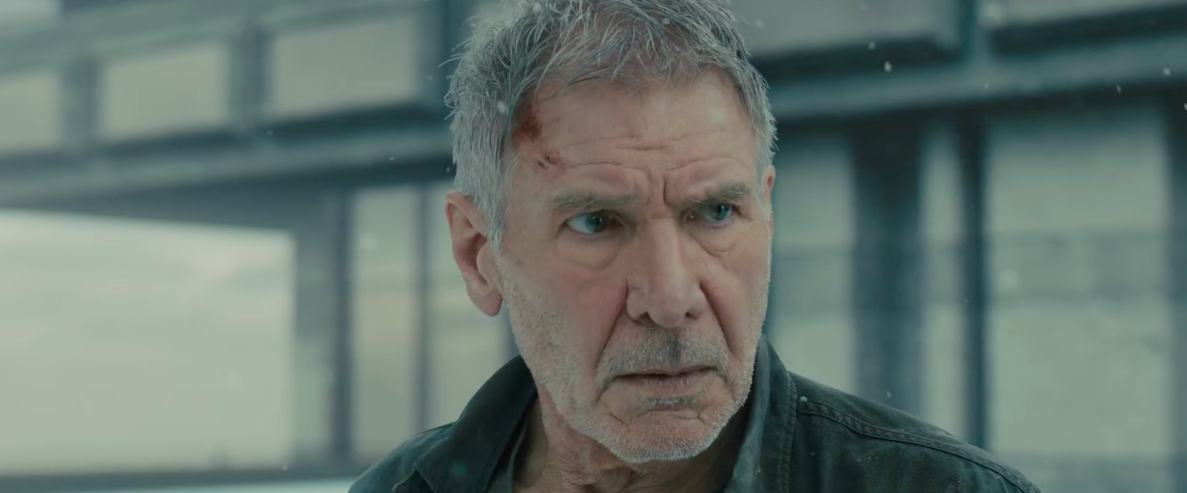
If you're unfamilar with Blade Runner, the story focuses on "synthetic humans" called "replicants" made by the Tyrell Corporation in the year 2019. Replicants are used for hard-labor in off-world colonies. A fugitive replicant group manages to escape back to earth, and LA cop Rick Deckard (Harrison Ford) has to "retire" them. Deckard's profession is referred to as a "blade runner."

The movie unfolds like a futuristic Raymond Chandler detective story, and by the end of the film Deckard is questioning his job and his loyalties. 

Fast forward 30 years, and we find dystopian Los Angeles looking much like it did in 2019 (a gloomy place featuring a doses of Japanese culture, mentions of the Soviet Union, and digital signs for defunct businesses like Pan Am and Atari).


Replicants have become more integrated into everyday life. The Tyrell Corporation has been bought out by the Wallace Corporation. Our main protagonist is a replicant — an LA cop who goes by the name K (Ryan Gosling).

K is investigating a growing effort by replicants to gain their freedom and remove the shackles of subservience. 


K's investigation begins with him traveling to a futuristic farm. He has been ordered to retire a rogue replicant named Sapper Morton (Dave Bautista). Morton knows why K has come, and challenges K's stone-cold duty by suggesting he has "never seen a miracle."

K kills Morton in a brutal, bar-like brawl. After the kerfuffle, K finds a buried box on the property containing the bones of a deceased replicant. When the remains are analyzed in a forensic lab back at LAPD headquarters, they discover the replicant gave birth via c-section. 

Replicants weren't thought capable of reproducing. As a result, K's superior (Robin Wright) orders the remains be destroyed (for fear it could start a mass conflict between humans and replicants). 

Despite the fact that K has been engineered from the ground up — and is typically a by-the-book blade runner — his nagging curiosity keeps him on the hunt to learn the identities of mother and offspring. As a result, he begins to question his own identity and place in the world.   


Thus unfolds a fascinating journey and investigation, featuring gorgeous set pieces and visual effects. K's pursuit of the truth eventually leads him to an exiled Rick Deckard.


When 1982's Blade Runner was released in theaters, the studio ordered narration for Harrison Ford's character be tacked onto the film — something director Ridley Scott was not in favor of, and something that was removed in subsequent re-releases. 

The Blade Runner films feel right without narration — adding an element of wonder to the narrative. 


As a result, the franchise will likely never have the mass followings of more pedestrian popcorn movies. Much has been made on the "interwebs" about the film not living up to box office expectations. 

Sometimes it's nice to have a story where viewers fill in the blanks for themselves. I'm pleased Denis Villeneuve stayed true to Blade Runner's original vision — even if it meant creating a less commercial film.

I must also commend Ryan Gosling's performance in Blade Runner 2049. 


Gosling once again proves his dependability as a leading man — a trait also on full display in his performance as Sebastian Wilder in 2016's La La Land (read my review).


His performance as K gives viewers a quiet, introspective loner who — despite being engineered — yearns for more meaning in his spartan existence. The closest K has ever come to experiencing love is a precocious hologram companion named Joi (Ana de Armas). Gosling's soulful stares speak volumes, and give depth to the film that goes beyond the written word. 

Blade Runner 2049 illustrates how science fiction films can rise above the typical crop of genre movies, and offer thoughtful, grown-up dramas that entertain and enlighten. 

Rated R, Runtime: 2 hrs, 43 min


Tuesday, October 10, 2017

About That New "Star Wars" Trailer, Poster, and Opening Night Fan Event


The long-awaited second trailer for Star Wars: The Last Jedi dropped last night. Fans had been wondering if/when they'd see a new trailer for the movie. Some fans are avoiding seeing any sort of spoiler ahead of time and are going "radio silent" as it regards "The Last Jedi." 

Even the movie's writer/director -- Rian Johnson -- suggested on his Twitter account that viewers should avoid this latest trailer if they wanted to avoid spoilers:


I'm not worried about spoilers. I've even read Star Wars movie tie-in novelizations before seeing the movies (back when they used to publish the tie-ins prior to the movie's release date) and it didn't bother me at all (you'll be happy to note that Star Wars: Attack of the Clones was much, much better in novel form...)


The new trailer for The Last Jedi offers some new nuggets for fans to obsess over. Be that as it may, you can tell the studio is keeping a number of things close to the vest. 

I'd also argue that a bit of deception and subterfuge are being implemented here. For example, at the end of the trailer we see Rey (is she a "Solo" or a "Skywalker") saying, "I need someone to show me my place in all this." Her face has an orange glow, and her tone is rather forboding. The trailer then cuts from her to a shot of series heavy Kylo Ren holding out his hand...which the viewer is led to believe is for Rey.  


The prevailing sentiment on the web is that this moment in the trailer is an act of clever editing on the part of the filmmakers. It doesn't seem terribly likely that Disney would want to unleash a mega-spoiler suggesting Rey is going to turn to the darkside. 

I'm not going to delve too heavily into all the intricacies of the trailer, but there are a number of cool looking shots.

We get to see more footage of Rey wielding Anakin/Luke Skywalker's lightsaber during her training:


We get to see Chewbacca and a Porg (Lucasfilm's latest cute and cuddly merchandising ploy) in the cockpit of the Millennium Falcon:


We also see a wicked looking battle between Finn and Phasma (a character many fans are hoping garners more screen time in The Last Jedi):


And we get to see BB-8 getting all "electrified" on Poe Dameron's X-Wing:


There are a number of other additional goodies in the trailer. If you're like me, you'll watch the trailer over and over and over again. 

If you want an in-depth analysis of this trailer, check out this video from the "Star Wars Explained" YouTube channel. I discovered this channel a few months ago. Alex Damon (and his wife, Mollie) do a nice job explaining all the intricacies of the Star Wars universe:


In addition to the new trailer, the poster artwork for the latest Star Wars: The Last Jedi one-sheet poster was released. 

While the lastest generation of Disney-produced Star Wars posters don't quite have the same magical quality of artist Drew Struzan's Star Wars work from yesteryear, this is a gorgeous poster:


And that's not all...

As cool as the new trailer and poster are, tickets are also now on sale for the Dec. 14 screenings of Star Wars: The Last Jedi.


I plan to attend the "Opening Night Fan Event" at Aksarben Cinema for The Last Jedi. If you live in Omaha, NE, I encourage you to join us for this event. 

Tickets are $20 apiece and secure your ticket to the 6 p.m. showing of The Last Jedi, bonus content before the movie, trading cards, and a free concession item (a small popcorn at Aksarben Cinema). 

Previous post: Still Rocking A Beeper? 

Thursday, September 28, 2017

Still Rocking A Beeper?


Many of you know I have an unnatural obsession with retro technology. Whether it is the aging television antenna in my attic, my old Super Nintendo Entertainment System, or my vintage iMac collection, I have a fondness for "blast from the past" gadgets.

It is in that spirit that I ponder the pager...or as it was often referred to back in the day, the "beeper."

Bridget and I frequently drive by the ATS "The Beeper People" building at 29th and Harney (near Downtown Omaha). 

Before Americans were tied at the hip to cellphones, my wife had a pager. We were in college at the time. She had it so her family could get ahold of her... or, as was the case with pagers in that era, you'd basically "signal" her. 

It was kinda handy -- especially when she was at work. I could call Bridget's beeper and type in my home number or a special code (I sometimes used 007... it made me feel like a spy). 

After the connection was made, you'd have to wait until she called back (which required being near a phone).

(As I type this it sounds like the electronic equivalent of sending smoke signals).

I can't remember how long Bridget had her pager.

She obtained her first cellphone in 1996. It was one of those foot-long beige bricks that looked like something used to call in artillery fire during World War II. 

I remember when we picked up the phone. Her uncle had us drive out along a desolate stretch of gravel road in western Douglas County. The phone was waiting for Bridget on the front seat of a 1960-something Dodge Dart, parked next to a dreary farmhouse.

(I can only imagine the look on my face at that moment.) 

But enough about that phone... You will be happy to know that pagers are still in use.

According to a 2016 story on Slate, 85 percent of hospitals still use pagers. The devices (in various forms) have been around since the 1950s. In addition, paging networks are apparently more reliable than cellular networks, and have more broadcast power. 

While cellphones and smartphones have cut into sales of pagers, they continue to serve a role in medical, emergency services, and other assorted industries. 

I can't recall the last time I saw someone sporting a pager. 

This scene from Tron: Legacy (where Alan Bradley tells Sam Flynn about a page he received from Sam's father) reminds me of the days when Bridget had a pager, and illustrates how the devices have become something of a humorous footnote in tech history:


"Oh man... Still rocking the pager. Alan, good for you." 


Tuesday, September 26, 2017

Two-Paragraph Tuesday: "Longmire" Arrived Today


Arriving in my mail today was "Longmire: The Complete Fifth Season" on blu-ray. The "Longmire" season sets, which are produced by the Warner Archive Collection, feature gorgeous transfers illustrating the best the format has to offer (they are near reference quality, in my opinion). That fact means the scenic beauty of New Mexico (which fills in as Wyoming for the series) can be experienced in all its 1080p glory. 

"Longmire" was canceled after its third season by A&E, then resurrected by streaming giant Netflix for three additional seasons (the sixth has yet to air). "Longmire" follows the exploits of Wyoming Sheriff Walt Longmire (Robert Taylor). The show is based on the bucolic book series by author Craig Johnson. I've had the opportunity to attend three of Johnson's book signings here in Omaha. It's worth your time to check out the book series and show.

Monday, September 25, 2017

"Star Trek: Discovery" Review


If the chatter on social media is any indication, the new CBS series Star Trek: Discovery is going to be gazed upon from every angle... analyzed and picked down to the finest detail. 
I'm not sure it has to do with the quality of the show itself (it is a handsome production), but more for the fact that viewers are trying to justify the expenditure of $5.99 per month to watch it (the show airs exclusively on CBS streaming platform CBS All Access). 
I found the first two episodes intriguing (I've been a CBS All Access subscriber for a couple years), and am curious to see what unfolds going forward. 
It is difficult to judge the quality of the 17-episode first season based solely on the 84 minutes available, but there were a couple twists that signal Star Trek: Discovery isn't the Trek of old.  
This show is set 10 years prior to the exploits of Kirk, Spock, and Co. 
The pilot episode ("The Vulcan Hello") sets forth with some sinister Klingon-subtitle-mumbo-jumbo about uniting against a common enemy (which we pretty much know will be our heroes in the United Federation of Planets). 
The story then shifts to a desert world where Captain Philippa Georgiou (Michelle Yeoh) and Lt. Commander Michael Burnham (Sonequa Martin-Green) are trudging along (in garb that looks like it was yanked from Rey's wardrobe in Star Wars: The Force Awakens) trying to solve the planet's massive drought... as a sandstorm looms.
Both officers serve aboard the Federation starship U.S.S. Shenzhou. We learn that Burnham is a xenoanthropologist (in addition to her first officer duties).
Georgiou and Burnham are able to get the water flowing. And, through some clever signaling by Georgiou, the two are able to avert the storm and beam back aboard the Shenzhou... 
Fade to opening credits...
It should be noted that Star Trek: Discovery -- like a number of these new-breed shows on streaming platforms -- boasts a unique main title sequence. In this instance, the entire structure focuses on animated concept art for the series:
Discovery is told through the eyes of Michael Burnham. Much has been made of the character's first name being "Michael," leading some fans to wonder if she is Star Trek's first transgender character.
The character's name isn't discussed in the first two episodes. 
We do learn her character is an orphaned human who was raised by Sarek (Spock's father) on Vulcan. She was the first human to attend the Vulcan Learning Center and the Vulcan Science Academy. 
The crew of the Shenzhou finds itself at the edge of Federation space as the main narrative gears up. They are tasked with investigating a damaged interstellar relay. 
Burnham theorizes that the relay was damaged in an attempt to attract Federation attention, based on information from science officer Saru. 
The crew soon discovers an "object of unknown origin" which they theorize could have caused the damage, and Burnham straps on a spacesuit to go to learn more.
What Burnham finds is a Klingon vessel of ancient origin. When she lands for analysis, it triggers the vessel, and our hero comes face-to-face with an angry Klingon. 
The Klingon is killed in the ensuing kerfuffle -- which serves as the catalyst for an all-out showdown between the Federation and the Klingon Empire. 
To go any further would reveal too much. It is worth the time to experience "The Vulcan Hello" (episode 1) and "Battle at the Binary Stars" (episode 2) for yourself. 
By the time the first two episodes are complete, a mutiny has been attempted aboard the U.S.S. Shenzhou, main characters are dead, and our protagonist's future is in limbo.
Unlike previous Star Trek iterations, the episodes in Discovery will be serialized and follow a unified track throughout the season. 
The look and feel of Star Trek: Discovery is top notch. The aesthetic borrows heavily from the J.J. Abrams Star Trek reboot movies with beautifully rendered visual effects and a healthy dose of lens flares and light glare. 
Based on the extended preview of the upcoming season, it appears that Burnham is far from the squeaky clean hero commonly seen in Star Trek outings, and viewers will be treated to emotional warts, bumps, and bruises. 
It also looks like there might be some notable guest appearances on the show. Rainn Wilson is set to play Harry Mudd -- a notorious con artist featured in two episodes of the original series. Perusing IMDb, it seems as if the character it set for a multi-episode arc.
The main debate in all of this is whether or not Star Trek: Discovery will have the intrigue necessary to hook viewers into subscribing to another streaming service.
Some fans have already lamented that the show isn't on Netflix (as it is in other countries). 
Whatever your opinion on the topic, Star Trek: Discovery proves itself an alluring entry into CBS's nascent streaming efforts. It also proves a well-tread franchise can still "boldly go..."

Sunday, September 24, 2017

As "Star Trek: Discovery" Debuts... I Look At The "CBS All Access" Streaming Service


To boldly go where no Star Trek series has gone before...

It has been a little over 12 years since any new form of Star Trek series has aired on television. 


The last voyage was called Star Trek: Enterprise -- a show designed to help set the fledgling UPN network to warp speed. (The UPN network eventually merged with The WB to form The CW Television Network). It never achieved the status that its predecessors reached. Not only that, the franchise during that era felt as if it was on life support. 


As fans and critics soured (and as viewing habits changed in the early 2000s), Star Trek was left in an odd sort of limbo. There weren't any new productions until May 2009 --  when J.J. Abrams's terrific Star Trek movie reboot debuted in theaters.


While Paramount might have squeezed the Trek orange dry in the 80s and 90s, time has a way of healing all wounds. Everything old is new again. 


Seth MacFarlane's oddly compelling Star Trek homage/parody series The Orville just debuted on Fox (I'll be reviewing that show soon), and CBS is set to debut Star Trek: Discovery on Sept. 24 as the flagship entry for its streaming service CBS All Access


For those who don't have CBS All Access, Star Trek: Discovery's first episode will air on CBS on Sunday, Sept. 24 (check local listings). So you can get a taste of the new show. 


The first two episodes of Star Trek: Discovery will debut on CBS All Access that same evening, with future episodes airing each week exclusively on the streaming platform. 


I haven't seen the debut episode yet (but will have a full review later this week). I do subscribe CBS All Access, and can give you a few insights on the service. 


Since CBS launched CBS All Access in 2014, it has evolved from a receptacle for the network's slate of recent TV episodes into a service that features full seasons (stacks) of current series, a library of "classic" shows owned by CBS (such as the entire Star Trek series catalog), an odd assortment of theatrical movies, events like the 24/7 Big Brother live feeds, and NFL broadcast streams (games that air on your local CBS affiliate). 


The service is $5.99 per month. There is also a $9.99 option that allows you to stream commercial free (my advice: pay the extra $4 per month for the commercial-free option).


Bridget and I are cord cutters and find "CBS All Access" to be a valuable tool in our streaming arsenal -- especially since we are big fans of Survivor, The Amazing Race, and Big Brother (along with various scripted series on the network). 


Depending on how you watch television, CBS All Access might feel unnecessary. Some would balk at the notion of paying a monthly fee for network programming. If you have cable TV, the service might seem like "overkill" when you can easily DVR the network's broadcast content. 


But CBS is trying to up the ante with original programming that is exclusive to CBS All Access. 


In February of this year, The Good Fight (a spinoff of the net's long-running series The Good Wife) debuted on "CBS All Access."


And now we get Star Trek: Discovery, a series that CBS has spent a considerable amount of time, money and effort producing and promoting. 


There is a considerable amount riding on this show for the network as viewing habits continue to evolve, and more consumers stream digital video content. 


If successful, Star Trek: Discovery could be the spark that fires up more "streaming-only" content production for CBS. 


If nothing else, it is good to see Star Trek back in an episodic format. Unlike previous Star Trek entries, it sounds as if Discovery will have longer story arcs that lean the direction of today's "binge-able" series. That should give the show room to breathe, and help writers create a compelling narrative. 


Stay tuned...!


Previous post: Two-Paragraph Tuesday: The Carcass of a Mall