Showing posts with label Ryan Gosling. Show all posts

Wednesday, March 25, 2026

Movie Review: “Project Hail Mary” is Amazing


By Jon Brooks 

The last time I watched a movie in the theater was July 2025. We took our nephew to see “Jurassic World Rebirth.” 

It was one of only two movies I viewed in a theater last year (the other was “Mission: Impossible – The Final Reckoning”). 

My movie habits have certainly changed in recent years. But for most of my life, attending movies in the theater was a near weekly occurrence. 

I’m not going to be one of those people who complains that there “aren’t any good movies anymore.” There are plenty of movies I enjoy. 

But the reality is that I yearn for the sort of original, non-sequel “popcorn movies” we saw in the 1980s and 90s. 

Studios desperately cling to the idea that viewers want 52 Marvel Cinematic Universe movies that — with each passing year — feel more and more like homework to keep track of than a light, fun movie-going experience.

“Project Hail Mary” arrived in theaters this past weekend, reminding viewers how much fun a standalone spectacle can be at the movies. 


“Project Hail Mary” is the theatrical adaptation of Andy Weir’s 2021 novel of the same name. 

Weir also wrote “The Martian,” which was adapted into a hit 2015 film starring Matt Damon. His second novel “Artemis” (read my review) is also being developed into a movie. 

Weir has a knack for writing sci-fi novels with likable characters and intriguing premises, mixing it all together a heaping dose of techno jargon. Through three novels, the concoction has proved itself to be surprisingly compelling. 

Each time I read one of his novels, I’m curious to see how they are going to adapt it for the big screen. 


“Project Hail Mary” centers around middle school science teacher Ryland Grace (Ryan Gosling). Grace is also a former molecular biologist. 

But in the early stages of the story, our protagonist doesn’t recall those facts… or any salient details of his life. He wakes up from a medically-induced coma on a space ship — a vessel heading to a distant solar system far away from Earth. 

His two crew mates died at some point during the ship’s multi-year journey. Grace is alone, confused, and scared as he tries to wrap his head around his current predicament. 


The movie (like the book) alternates between present day scenes and a series of flashbacks as our hero pieces together details of his past and tries to solve what brought him to this point. 

Overall, the narrative structure works. 

We soon learn that Grace and his compatriots were sent on a mission to save Earth. Specifically, the Sun is dimming. A mysterious microorganism dubbed “Astrophage” is causing the problem. If it isn’t stopped, the amount of sunlight reaching Earth will be too dim to sustain life in its present form. 


This effort creates the main hook for the storyline in “Project Hail Mary.” 

I know what you’re thinking. The plot sounds fairly similar to Christopher Nolan’s 2014 film “Interstellar.” 

While “Project Hail Mary” does hit some of the same beats, the tone is decidedly less brooding in nature. 


The stakes are just as high, but “Project Hail Mary” infuses doses of humor and levity to keep the audience engaged. 

It’s a smart choice that sets it apart from similar sci-fi fare. 

Directors Phil Lord and Christopher Miller deserve much of the credit for that. 

Lord and Miller have directed family-friendly flicks like “The Lego Movie” and the comedic “21 Jump Street” franchise. They produced and co-wrote the animated “Spider-Verse” movies for Sony (read my review of “Spider-Man: Into the Spider-Verse”). 

They were also originally at the helm of “Solo: A Star Wars Movie” (read my review), but were fired after four-and-a-half months of filming. Ron Howard was brought in to reshoot much of that movie. I have always wondered what the Lord and Miller version of “Solo” would have been like (had they been given leeway to do what they wanted to do). 

The talented pair has shown an ability to bring a stylistic flair and energy to the projects they work on. 

Those talents are certainly on display in “Project Hail Mary.” 

The movie is bright and colorful, and the set of the Hail Mary spaceship is fascinating to look at. 


The screenplay adaptation of Weir’s novel was written by Drew Goddard. Goddard also wrote the screenplay for Weir’s 2011 novel “The Martian.” 

Having read all three of Weir’s novels, it seems like it would be quite a challenge to synthesize his stories into a sensible screenplay. “Project Hail Mary” is Weir’s most ambitious novel to date (the book is more than 500 pages long).

But Goddard seems to have the “Midas touch” in that regard.  


While there are certain parts of the novel that were tweaked and/or removed for the movie, Goddard did an excellent job whittling things down to fit in the 156-minute runtime. 

The film is paced well and it retains the unique DNA of Weir’s novel. 

In my opinion, the biggest challenge for the filmmakers was the alien creature Rocky. The character is encountered by Grace during his mission and has been featured in various trailers and promotional materials for the film. 


Weir spent considerable time in the novel describing the melodic language of the character (musical notes were used in the book’s printed text) and put a lot of effort into creating a rationale for the creature’s physiology.

I wasn’t sure how it would translate to the screen, but they did a credible job pulling it off. It could have been really cheesy, but the character worked. It is an impressive feat considering the fact that the filmmakers opted to primarily use a puppet for Rocky (with CGI enhancements where needed). 


There were also a few nice supporting performances in the movie. 

One character that should be highlighted is Eva Stratt (Sandra Hüller). She leads the international task force addressing the global Astrophage crisis and is the individual who recruits Grace for the project. 


Hüller does a good job creating the “blunt school marm” vibe of the character in the novel. You can see the weight she carries as she’s tasked with saving humanity. 

(In the movie, the character mentions that she grew up in East Germany. In the book, she was Dutch.) 

One other aspect of the production I’d like to highlight is the film’s score by Daniel Pemberton. I’m actually listening to the soundtrack as I type this. 

Pemberton’s score takes a different approach than the soundtracks often featured in these sorts of films. It would have been very easy to do some sort of grandiose orchestral score that sounded like a cheap Hans Zimmer ripoff. 

Instead, Pemberton’s score has moments of electronic bouyancy and whimsy. There are also passages that sound almost tribal in nature. 


In addition, there are some haunting choral arrangements in the soundtrack that bring a religious flavor to certain heady moments in the movie. 

Put together with the pop music featured in the film (such as Harry Styles’ hit “Sign of the Times”), the musical underpinnings give “Project Hail Mary” a unique spirit. 


I want to mention what a fan of Ryan Gosling I’ve become the past decade. 

I remember thinking how much presence he had (with very little dialogue) in 2017’s “Blade Runner 2049” (read my review). 

While he has proven his chops doing brooding protagonists, he’s also shown considerable range creating endearing characters in broad comedies like “The Fall Guy” and the stylish hipster musical “La La Land” (read my review). 

In an age where people say there “aren’t really any movie stars anymore,” Gosling is one of this generation’s most compelling actors. 

He did a terrific job balancing the comedic, poignant, and tragic moments in “Project Hail Mary.”  

Ryland Grace epitomizes the “reluctant hero” in fiction. Gosling’s performance fits the character’s self-effacing demeanor to a T. 


Gosling is starring in the upcoming film “Star Wars: Starfighter” (directed by Shawn Levy). I’m curious to see if he can infuse new life into the “Star Wars” franchise (which has had its struggles in recent years). He might just be the actor to pull it off.

I could probably type a thousand more words about “Project Hail Mary,” but I’m going to leave you with this thought. 

Numerous fans online have pointed out the religious undertones in “Project Hail Mary.” In particular, the ship in the movie is called the Hail Mary and our protagonist’s name is Ryland Grace. 

It has been theorized that it could be a nod to the Catholic prayer "Hail Mary, full of Grace." 

At a time when movie theaters are struggling to bring back audiences to pre-pandemic levels, “Project Hail Mary” reminds us what a magical experience it can be to watch an original, energetic, and lovingly-crafted “popcorn movie” at the cinema. 

Gosling himself addressed this issue to fans at a recent screening of “Project Hail Mary.” The video clip has gone viral, and what he said to the attendees has struck a chord: 


“It’s not your job to keep [theaters] open, it’s our job to make things that make it worth you coming out…” 

“Project Hail Mary” is one of those movies that’s worth the price of admission. 

See it on the biggest screen you can find (I watched it on an IMAX screen… and it was amazing!) 

Totally recommended. 

Rated PG-13, Runtime: 2 hrs, 36 min 


>> If you enjoyed my review of “Project Hail Mary,” be sure to follow me on Twitter/X: @TheJonCrunch 

Tuesday, January 23, 2018

The Lost Review: “Is ‘La La Land’ All That?”


Editor’s Note: I wrote this review of “La La Land” on Feb. 5, 2017. For some reason, I never published it. I’m not sure why. But the movie was a favorite of my brother-in-law Sean Weide, who ended up seeing it a total of nine times at Aksarben Cinema. Sean died in May 2017. I revisited “La La Land” on Blu-ray the week he died, and also ordered the soundtrack on CD (I like physical media). The movie makes me think of him, and his incessant pleadings to check it out. There are many times I wish he was around so I could discuss this breezy and poignant movie with him, but alas...

From Feb 5, 2017:

By Jon Brooks 

I finally saw critical darling "La La Land" — the movie that's been singing and dancing its way through awards season (garnering 14 Oscar nominations). 

I'd had every intention of seeing the movie when it debuted in December. In the ensuing weeks, my Facebook and Twitter feeds have been filled with positive audience reactions, with a number of the testimonials gushing (my brother-in-law has seen "La La Land" seven times to date). 

Every so often, a film is released that captures the romance of a bygone era in cinema — movies that harken back to a simpler time, when stories eschewed dark and brooding narratives for something with the light froth of a freshly blended milkshake. 

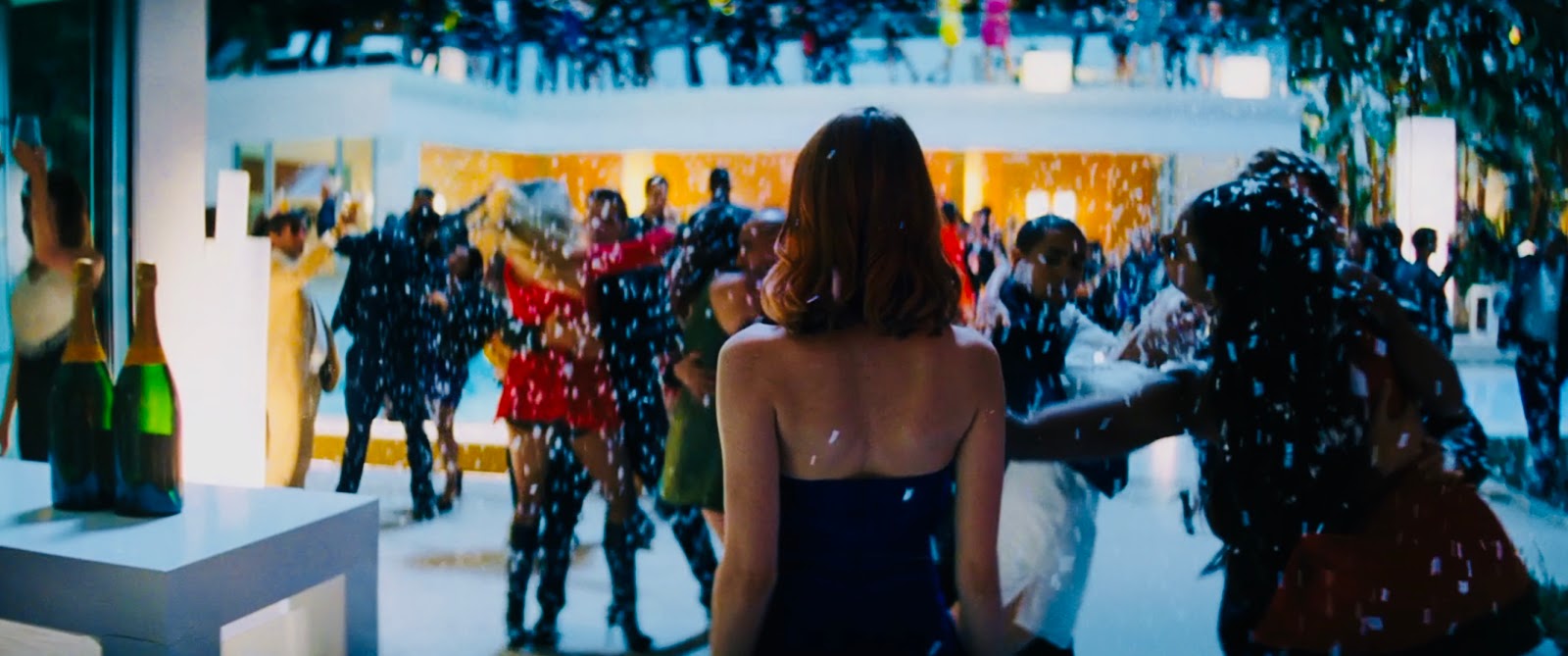
"La La Land" attempts to infuse the world of classic movie musicals with a hipster sensibility. 

It's less of a showy stage play than its forefathers in that regard, opting instead for an understated elegance and a subdued vibe. 


"La La Land" tells the story of struggling actress Mia Dolan (Emma Stone) and misunderstood jazz pianist Sebastian Wilder (Ryan Gosling). Both are trying to stay afloat in Hollywood: Mia as a movie studio barista and Sebastian as a lounge musician. Neither is particularly happy.

Mia and Sebastian's paths first cross in a traffic jam on Los Angeles freeway (which features one of the movie's most whimsical song-and-dance sequences). 


Two additional encounters happen (both involving unfortunate piano gigs for Sebastian) before the relationship's seeds are planted, and their bond starts to bloom. 

The characters are kindred spirits, and are able to help one another navigate the treacherous waters of Hollywood. Mia — disillusioned with a series of failed auditions — eventually decides she wants to stage her own one-woman play, while Sebastian tours with a pop artist (played by John Legend), in hopes of raising capital to start his own jazz club. 


Their dreamlike journey is strewn with gentle humor, and punctuated with musical cues throughout.

I'm sure the question on your mind is this: Does the film live up to the hype? 

Much as the movie itself doesn't deal in absolutes, neither does the answer to that question. 

Director Damien Chazelle has written/directed a movie that is buoyant and romantic, something in short supply at the cinema today (I really need to do a blog post on the relative dearth of romantic comedies out there).

Chazelle also chose to tell the story in musical form — something we generally only see in animated fare these days. 

Compared to the typical Oscar bait, it stands out as something different. Therein lies part of the appeal to the awards show circuit and critical "best of" lists. 

And the performances by Gosling and Stone — who dominate the narrative — are really solid in "La La Land."

My only quibble is that there were certain moments that felt a tad bit slow. 

I've heard from multiple individuals that the movie actually improves with additional viewings, so I will have to see it again. 

If you haven't yet seen "La La Land," you should see what all the hype is about for yourself. 

Rated PG-13, Runtime: 2 hrs, 8 min 

>> If you enjoyed my review of “La La Land,” consider following me on X/Twitter: @TheJonCrunch 


Postscript: Anyone who watched the Academy Awards in 2017 will recall the Warren Beatty SNAFU where he announced "La La Land" as the Best Picture winner... only to be corrected moments later with announcement that "Moonlight" was the actual victor. Personally speaking, I think it is a crime that "La La Land" didn't win. I've watched the movie numerous times on Blu-ray, and my appreciation grows on each subsequent viewing. 

John Legend's character Keith says to Sebastian in the movie, "Jazz is about the future." By the same token, "La La Land" should be a template for how filmmakers approach stories in the future.  

Sunday, October 22, 2017

Movie Review: "Blade Runner 2049"


By Jon Brooks

I love it when Hollywood goes back and pulls some of the more cult science fiction gems out of the vault — continuing the story for a new generation. 

I'm not talking about "eternal" franchises like Star Wars or Star Trek (although, I love what they've done with those properties in recent years). 

I'm referring to one-off movies like Tron — pieces of pop culture nostalgia that didn't gain mass appeal on initial release, but cultivated niche followings as the films fermented. 

In my mind, 2010's Tron: Legacy (a sequel/reboot to the 1982 original) was woefully underappreciated. I think that had less to do with the quality of film itself, and more to do with the fact that Tron was forgotten footnote in the genre. 

In a similar fashion, Columbia Pictures and Warner Bros. bring us Blade Runner 2049.

Blade Runner 2049 is a hybrid sequel/reboot to 1982's Blade Runner (it seems '82 was a good year for ground-breaking science fiction films that failed to find box office glory). 


Despite the film's near three-hour length, I was mesermized by Blade Runner 2049.  

Blade Runner 2049 is compelling eye candy — cerebral and thoughtful in its approach. If you're hankering for something loud and combustible, you'd best look elsewhere. 

The film is directed by Denis Villeneuve. His 2016 film Arrival (read my review here) also eschewed the trappings of today's bombastic sci-fi films, and aimed for territory more vague and intellectual. 

That style stays true to Ridley Scott's 1982 original (based on the Philip K. Dick story Do Androids Dream of Electric Sheep?). 

I saw Blade Runner in the mid-1980s. My family rented it on VHS tape from an Applause Video store near our home in Omaha, NE. 

While I never warmed up to the film the way I did the Star Wars franchise (or even 1982's Tron), it was certainly memorable for its stunning visuals, ominous soundtrack (by new age fave Vangelis), and dystopian view of Los Angeles in the future. 

If you're unfamilar with Blade Runner, the story focuses on "synthetic humans" called "replicants" made by the Tyrell Corporation in the year 2019. Replicants are used for hard-labor in off-world colonies. A fugitive replicant group manages to escape back to earth, and LA cop Rick Deckard (Harrison Ford) has to "retire" them. Deckard's profession is referred to as a "blade runner."

The movie unfolds like a futuristic Raymond Chandler detective story, and by the end of the film Deckard is questioning his job and his loyalties. 

Fast forward 30 years, and we find dystopian Los Angeles looking much like it did in 2019 (a gloomy place featuring a doses of Japanese culture, mentions of the Soviet Union, and digital signs for defunct businesses like Pan Am and Atari).


Replicants have become more integrated into everyday life. The Tyrell Corporation has been bought out by the Wallace Corporation. Our main protagonist is a replicant — an LA cop who goes by the name K (Ryan Gosling).

K is investigating a growing effort by replicants to gain their freedom and remove the shackles of subservience. 


K's investigation begins with him traveling to a futuristic farm. He has been ordered to retire a rogue replicant named Sapper Morton (Dave Bautista). Morton knows why K has come, and challenges K's stone-cold duty by suggesting he has "never seen a miracle."

K kills Morton in a brutal, bar-like brawl. After the kerfuffle, K finds a buried box on the property containing the bones of a deceased replicant. When the remains are analyzed in a forensic lab back at LAPD headquarters, they discover the replicant gave birth via c-section. 

Replicants weren't thought capable of reproducing. As a result, K's superior (Robin Wright) orders the remains be destroyed (for fear it could start a mass conflict between humans and replicants). 

Despite the fact that K has been engineered from the ground up — and is typically a by-the-book blade runner — his nagging curiosity keeps him on the hunt to learn the identities of mother and offspring. As a result, he begins to question his own identity and place in the world.   


Thus unfolds a fascinating journey and investigation, featuring gorgeous set pieces and visual effects. K's pursuit of the truth eventually leads him to an exiled Rick Deckard.


When 1982's Blade Runner was released in theaters, the studio ordered narration for Harrison Ford's character be tacked onto the film — something director Ridley Scott was not in favor of, and something that was removed in subsequent re-releases. 

The Blade Runner films feel right without narration — adding an element of wonder to the narrative. 


As a result, the franchise will likely never have the mass followings of more pedestrian popcorn movies. Much has been made on the "interwebs" about the film not living up to box office expectations. 

Sometimes it's nice to have a story where viewers fill in the blanks for themselves. I'm pleased Denis Villeneuve stayed true to Blade Runner's original vision — even if it meant creating a less commercial film.

I must also commend Ryan Gosling's performance in Blade Runner 2049. 


Gosling once again proves his dependability as a leading man — a trait also on full display in his performance as Sebastian Wilder in 2016's La La Land (read my review).


His performance as K gives viewers a quiet, introspective loner who — despite being engineered — yearns for more meaning in his spartan existence. The closest K has ever come to experiencing love is a precocious hologram companion named Joi (Ana de Armas). Gosling's soulful stares speak volumes, and give depth to the film that goes beyond the written word. 

Blade Runner 2049 illustrates how science fiction films can rise above the typical crop of genre movies, and offer thoughtful, grown-up dramas that entertain and enlighten. 

Rated R, Runtime: 2 hrs, 43 min 

>> If you enjoyed my review of “Blade Runner 2049,” consider following me on X/Twitter: @TheJonCrunch