Wednesday, February 26, 2020

Review: “Star Trek: Picard” Season 1, Episode 5 (CBS All Access Series)


“Murder is not justice. There is no solace in revenge.” 
Jean-Luc Picard in “Stardust City Rag” 

SPOILERS AHEAD!

Welp, here we are at the midway point of the first season of “Star Trek: Picard.” 

The fifth episode is titled “Stardust City Rag” and it finds our heroes visiting a place called Freecloud as they search for scientist Bruce Maddox (John Ales) — the man behind twin android sisters Dahj and Soji Asha. 

They’ve teased Freecloud the past couple of episodes. Freecloud’s look is sort of a cross between the casino planet Canto Bight in “Star Wars: The Last Jedi” (read my review) and the “Oasis” in the movie “Ready Player One” (read my review). 


I enjoyed the holographic “ads” that appeared on the bridge of La Sirena when it came into orbit of Freecloud. They were kind of a fun little detail… 


We find out that “7 of 9” (Jeri Ryan) is a Fenris Ranger and that the rangers keep their money on Freecloud — so it was sort of serendipitous that they ran into her in the last episode. 

This isn’t the first time they’ve mentioned “Fenris Rangers” in “Star Trek: Picard,” so I looked them up. 


Fenris Rangers (according to the first season press kit) are “an independent group of peacekeepers who try to maintain a semblance of law and order on both sides of the former Neutral Zone.” 

In a nutshell, they are vigilantes. 

Raffi (Michelle Hurd) has been trying to make her way to Freecloud throughout the first half of the season — hence the reason she decided to hitch a ride on Picard’s mission. Her  Freecloud aspirations were wrapped in mystery until this episode. 

It turns out she wanted to reunite with her estranged son Gabriel (Mason Gooding). She finds out her son is about to have a baby with his Romulan wife.


As is the case with estranged children in TV dramas like this, Gabriel rejects his mother’s overtures and doesn’t believe she is a changed woman. Spurned and rejected, Raffi returns to La Sirena by the end of the episode. 

The whole sequence felt a bit contrived. As I mentioned, it is a fairly common narrative technique to have an estranged child reject a parent in an ambivalent manner. The technique is often employed to stir up feelings of sympathy for a character with an icy demeanor. 


Picard (Patrick Stewart), Rios (Santiago Cabrera), Elnor (Evan Evagora), Jurati (Alison Pill), Raffi, and “7 of 9” hatch a plan to snatch Bruce Maddox from the grip of a Freecloud crime boss named Bjayzl (Necar Zadegan). 


While the plan is somewhat ridiculous, there are some fun moments as our heroes try to bargain with Bjayzl to hand over Maddox (the ruse is built around a scenario involving a trade of “7 of 9” for the scientist). 

We learned in the season premiere of “Star Trek: Picard” that Agnes Jurati had a professional relationship with Dr. Maddox. 

In this episode, we find out that their relationship veered into the romantic along the way. 


That’s what makes it so puzzling when Jurati murders the rescued Maddox in the La Sirena sick bay at the end of the episode. 

As Maddox gasps his final breath, Jurati tearfully says, “I wish you knew what I know. I wish I didn’t know what I know. I wish they hadn’t shown me. I’m so sorry.”


I’ve been wondering if there was more to Dr. Jurati than meets the eye. I know people online have wondered whether she might be an android herself.

I don’t know what the answer is. I don’t think she’s an android, but there is definitely something odd going on with her. 

“Stardust City Rag” was an entertaining episode. 

It didn’t move the needle a whole lot as far as the overall narrative goes, but at least Picard learned he needs to visit “The Artifact” to find Dahj’s twin sister. Frankly, I’m glad they’re not going to spend the entire season trying to figure that out. 

I still think the show relies a bit too much on easter eggs and “fan service” moments from previous “Trek” lore. I’m hopeful the second half of the season will be able to shed the nostalgia and truly evolve into its own living, breathing thing.  

==============================

Monday, February 24, 2020

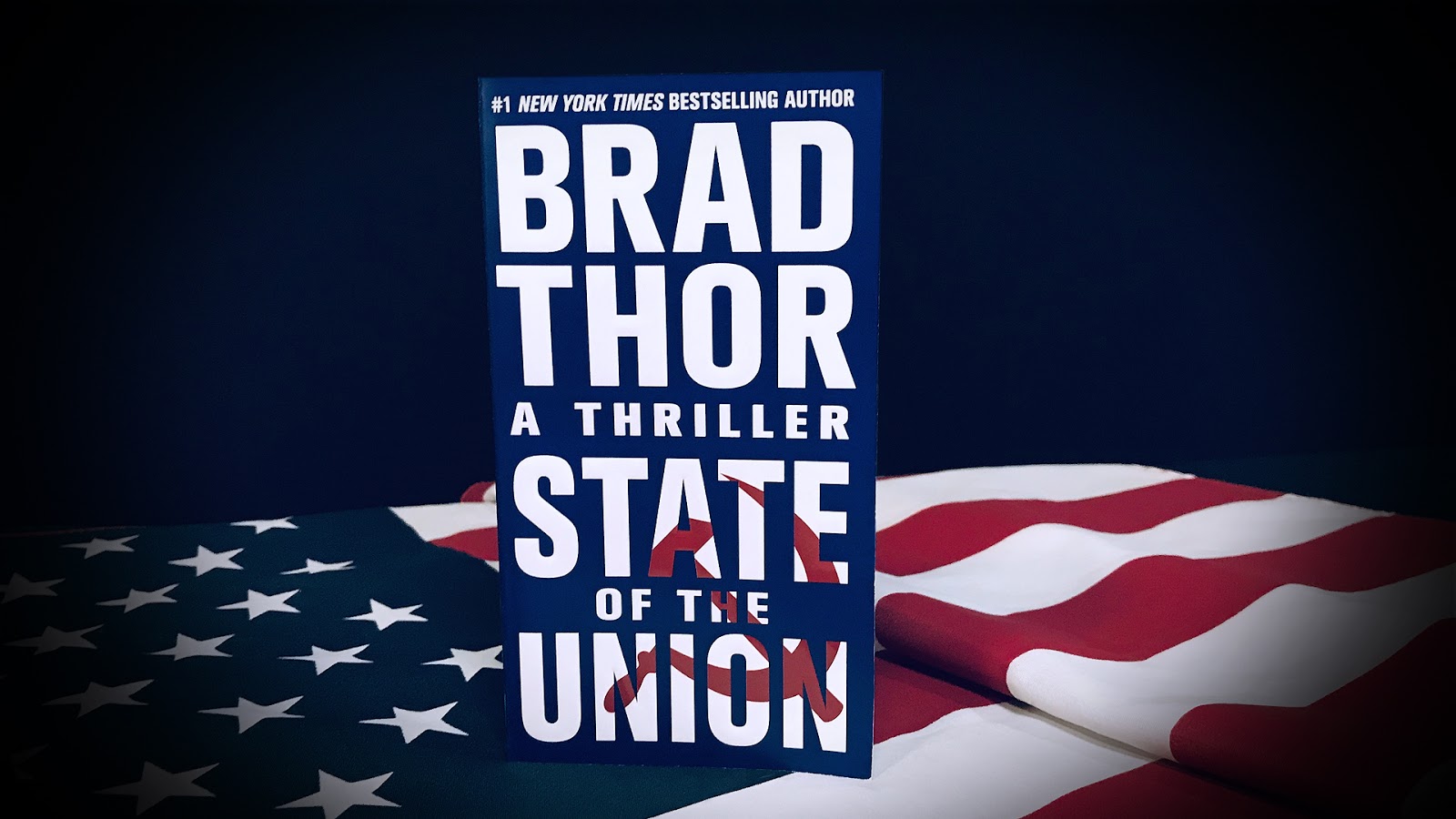
Book Review: “State of the Union” By Brad Thor


“What if the Cold War didn’t end? What if we thought it had ended, 
but the Soviets were just playing possum?” 
President Jack Rutledge in “State of the Union” 

I own a lot of books. Some would say I own too many. 

But really, can you ever have too many books?

Over the years, I’ve collected book series with plans to one day finish them. Like many of you, I’ll discover a talented writer, read a book in his/her series, like it, and quickly gather the rest. I have shelves and totes holding full series that are waiting patiently to be read. 

At some point, you have to bite the bullet, set a deadline, and read all the books. 

A lot of the people I follow on Twitter are big fans of Brad Thor’s novels. They tweet glowing reviews, plan vacations around the release of his novels, and have an unabashed enthusiasm for the 19 thrillers he has written (as of this writing). 


I own all of his books, but really wanted to go back and “fill in the gaps” in order, from the beginning. 

A few years ago, I read his first novel “The Lions of Lucerne” in hopes of accomplishing this task — before I had this blog. Sadly, I didn't stick with the plan, and have fallen further behind. 

Thor’s next novel is titled “Near Dark” and will be released June 23, 2020. He unveiled the cover and title in January: 


I decided it was time to read — and review — the 14 novels I had yet to read before “Near Dark” is released. It gives me a firm deadline (which is helpful when “binge reading” books). 

First up on the docket is Thor’s third novel “State of the Union.” 

This time out, dependable operative Scot Harvath is investigating the disappearance of colleague, family friend, and mentor Gary Lawlor. 

Lawlor heads up an international branch of the Department of Homeland Security dubbed the Office of International Investigative Assistance (OIIA). Harvath works for the organization, and Lawlor’s sudden disappearance is cause for concern in President Jack Rutledge’s administration. 

For the uninitiated, Harvath is a former U.S. Freestyle Ski Team member who studied at USC (the university Thor attended), became a U.S. Navy SEAL (serving on two SEAL teams — including the “Polar SEALS”), and was later recruited by the Secret Service to improve White House operations and security. 

Readers discover in the opening pages of “State of the Union” that nefarious forces inside modern-day Russia are hatching a plan to bring the United States to its knees. 

Lawlor’s disappearance is tied to that plan — a deadly plot with origins in the Cold War. (We learn about a dormant program he was involved in called “Dark Knight” that appears to be related to his disappearance.)

The scheme is put into motion days before Rutledge’s State of the Union address. As a result, the president’s head is being held over a proverbial barrel, and demands are made regarding the content of his address to the nation. 

Harvath must race against the clock — traveling to Germany and points beyond — to learn the fate of Lawlor and thwart Russia’s plan. 

Despite the fact that “State of the Union” was published in 2004, there is something eerily topical about the storyline for today’s readers. 

Thor is adept at plotting and pacing. He sprinkles in various anecdotes and facts to add credibility to his narrative. 

For example, during sequences in Berlin, Thor includes something called “ghost stations” found in Berlin’s U-bahn metro rail system.

Those metro stations were split off during the Cold War (when the Soviet Union built the wall dividing Berlin).

“Because of a quirk in geography,” writes Thor, “two of the West Berlin lines needed to pass briefly through East Berlin before circling back around to the West. It was very strange. You could ride through East Berlin and see stations like this completely abandoned except for the stern-faced soldiers standing on the platforms with machine guns.” 

When I read that passage in the novel, I had to pull out my iPad Pro to do a bit of research. Sure enough, I found some interesting information about the “ghost stations.” 

It was neat to be able to learn about a piece of history I was unfamiliar with before reading the novel. 

Like a number of his contemporaries, Thor manages to throw in various “tools of the trade” to enhance the verisimilitude in his novels. 

Whether it is a mention of Harvath’s .40-caliber SIG Sauer P229 — or a description of a Mi-17-1V assault helicopter — Thor does a good job with the technical aspects of his stories. 

As it regards the Mi-17-1V, I looked it up online (I like to be able to picture the aircraft mentioned) and found out that the helicopter is based on an airframe built in the 1970s for the Mil Mi-8 “Hip.” 

It is one of two interesting helicopters featured in “State of the Union.”

When I was a kid, I enjoyed building model airplanes and developed a fascination for military aircraft. My parents bought me a copy of “Jane’s World Aircraft Recognition Manual” in 1982. So I pulled my well-worn copy off the shelf to see if I could find the Mi-8 helicopter. Sure enough, I did: 


“State of the Union” epitomizes what made the “early era” Brad Thor novels great. The first three entries in the Harvath series remind me a lot of Robert Ludlum during his prime. 

I should also point out that “State of the Union’s” geographic descriptions are top notch. That might have to do with Thor’s extensive knowledge of Europe developed during his time hosting the PBS series “Traveling Lite” (a show he created and produced).  


Next on the agenda is “Blowback.” I’ve read the first few chapters and I’m already intrigued. Stay tuned for my review!

If you’d like to learn more about the world of author Brad Thor, visit his website: www.bradthor.com. 

More blog content on Brad Thor: 


Wednesday, February 19, 2020

Review: “Star Trek: Picard” Season 1, Episode 4 (CBS All Access Series)


“I don’t have the right, but I need your help one last time.”
Jean-Luc Picard in “Absolute Candor”

SPOILERS AHEAD!

The fourth episode of “Star Trek: Picard” is titled “Absolute Candor” and features our titular hero spending the episode assembling his team and revealing more Roman lore.

At the end of the last episode, we saw Picard (Patrick Stewart) depart earth on the ship La Sirena with Rios (Santiago Cabrera), Raffi (Michelle Hurd), and Dr. Jurati (Alison Pill). 

They were headed to search for Soji Asha, twin sister of the android Dahj — who came to see Picard in the first episode of the season, and was murdered by a group of Romulan secret police called the Tal Shiar (who might also be part of an ancient cabal known as the Zhat Vash).

Full disclosure: I had to look up the names “Tal Shiar” and “Zhat Vash” because I’d forgotten what the Romulan bad guys were called in the week since I wrote my last review.  

Anyhow, this week's episode has Picard visiting a group of Romulan warrior assassin nuns (yes, there is apparently such a thing) known as the Qowat Milat on the planet Vashti.


The nuns practice “absolute candor” — which means they say what they think unfiltered (like Jim Carrey’s character in the movie “Liar, Liar”). 

Picard forged a relationship with the warrior assassin nuns (I love typing that) during his Romulan relocation efforts 14 years prior. At that time, he befriended a boy who was being raised by the nuns, named Elnor (Ian Nunney). 


Fast forward 14 years... Picard needs some “muscle” for his current mission, and Elnor (now an adult played by Evan Evagora) is still living on Vashti and has been trained in the warrior assassin nun methods. 


They wield a special kind of sword known as the “tan qualanq.” The order can be bound to a singular cause known as the “qalankhkai.”  

(There is obviously some sort of “Romulan random word generator” online I don’t know about...)


Let’s face it, Elnor and the nuns are basically the “Star Trek” equivalent of the Jedi Knights. I’m totally fine with that. Their presence might make this series more appealing as the season progresses. 

Speaking of appealing, I am digging the clothes they wear in the 24th century. I’m so happy they've scrapped the endless array of ugly jumpsuits for clothes that look similar to the fashions of today. 


There’s something comfortable and relatable about the clothes in “Star Trek: Picard.” 

The outfits are designed by Christine Bieselin Clark. Clark’s credits include movies like “X-Men Origins: Wolverine” and Disney’s upcoming “Jungle Cruise.” You can learn more about her costume work at www.christineclarkdesign.com.

We dive a little bit more into the relationship between Soji and her Romulan love interest known as Narek (Harry Treadaway). Narek is working for the nefarious Zhat Vash cabal, and is in place to try and learn from Soji where a “nest” of androids might be located.


Frankly, I don’t know what Soji sees in this guy. At this point, he just seems like narrative tool (no pun intended) designed to reveal more about Soji — and the Zhat Vash’s plan — to viewers. 

(I know they’re trying to play the angle that he’s conflicted about his relationship with Soji, but she seems too smart not to see through all his overtures). 

The Soji/Narek interactions in the fourth episode manage bring into question the veracity in Soji’s backstory. He questions her head on during the episode. 


At the end of “Absolute Candor,” the former Borg drone “7 of 9” (Jeri Ryan) is beamed aboard La Sirena during a space battle with a Romulan Bird of Prey.  


The “7 of 9” character was introduced in the series “Star Trek: Voyager” (during the show’s fourth season). The character was originally born Annika Hansen. She was liberated from the Borg collective by the crew of the U.S.S. Voyager.  

It’ll be interesting to see how her character figures into the overall storyline. I didn’t watch a lot of “Voyager,” so I’m pretty vague on “7 of 9” (even though it was a popular character). 

It seems like she’ll bring an interesting dynamic to the series (and should be helpful in the hunt for Soji). 


Overall, I found the “Absolute Candor” episode to be the strongest since “Star Trek: Picard’s” first episode. The narrative primarily focused on Picard in this episode, and that’s always a good thing. 

I’ve been enjoying the assembly of Picard’s “crew” the past couple of episodes. I know some folks online have suggested that the supporting cast is bland, but I like how things are developing. 

==============================


Previous post: Review: “Star Trek: Picard” Season 1, Episode 3 (CBS All Access Series) 

Wednesday, February 12, 2020

Review: “Star Trek: Picard” Season 1, Episode 3 (CBS All Access Series)


“I’m not in the habit of consulting lawyers before I do what needs to be done.” 
Jean-Luc Picard in “The End is the Beginning”

SPOILERS AHEAD!

The third episode of “Star Trek: Picard” answers some questions and poses more questions for viewers of the new series. 

The episode is titled “The End is the Beginning.” 

First of all, we get a flashback sequence at the beginning of the episode that explains a bit of the relationship between Jean-Luc Picard (Patrick Stewart) and Raffi Mussiker (Michelle Hurd) — 14 years before the events of “Picard.” She was Picard’s first officer when he was working on saving the Romulan race from a supernova. 

Some fans have found it off-putting that Raffi refers to Picard as “JL” in this sequence. It didn’t bother me. 


We learn more about Picard resigning from Starfleet during this flashback (although we don’t see it happen on screen). As a result of his resignation, Raffi loses her security clearance and job. 

A video on the ScreenCrush YouTube channel brought up a number of interesting points about contradictions being introduced in “Star Trek: Picard” that are antithetical to the universe that has been established. 


For example, why does Raffi express disdain for Picard’s chateau lifestyle when the Federation is supposedly a utopian-type world where people no longer work for money?

Also, why are so many people smoking during “Star Trek: Picard’s” third episode? Was it done to create an edgier vibe for the show?

Something Bridget commented on were the F-bombs dropped during the second episode (a colorful expletive also heard in the CBS All Access series “Star Trek: Discovery”). 

None of these things are a big deal on their own, but it brings into question whether a “Star Trek” series should take the prequel/sequel approach within existing properties, or if reboots like J.J. Abrams’s “Star Trek” movies are the better way to go. 

While I’m well aware the Leonard Nimoy appeared as Spock 2009’s “Star Trek,” I also know that Abrams did something that felt fresh and unique. His movies didn’t feel hindered by the things that came before. 

Anyhow, the third episode manages to get things back on track as far as the narrative goes in “Star Trek: Picard.” 

Despite long-standing bitterness, Raffi helps Picard with his request to find an off-the-books pilot with an unregistered starship. The pilot is Cristobal Rios (Santiago Cabrera), the former XO of a heavy cruiser called the ibn Majid — a ship that made the Kessel Run in less than twelve parsecs (just kidding!) 


Rios is sort of a roguish Han Solo-type. His ship is called La Sirena. Initial impressions are that I like the character and look forward to seeing more of him in action. 

The plot thread involving Soji Asha (Isa Briones) on the Artifact (the former Borg Cube) continues to develop. We learn the former Borg, Hugh (Jonathan Del Arco), is running operations with the Borg Artifact Research Institute. 

Bringing back the character Hugh was another tie-in to “Star Trek: The Next Generation.” Picard and the crew of the Enterprise first met Hugh (referred to as Third of Five) in an episode titled “I, Borg.” Chief Engineer Geordi LaForge gave him the name Hugh. 


In “I, Borg,” Hugh was a teenage Borg drone — one that exhibited individualistic traits. 

The character also appears in the two-part episode of TNG called “Descent” (that covered the sixth season finale and the seventh season premiere). 

I remember the character, but it’s been ages since I’ve seen those episodes. 

The good news for viewers is that “Star Trek: The Next Generation” is available to stream on CBS All Access, Amazon Prime Video, Netflix, and Hulu. You can go back and check out these episodes.  

Back to “Picard”… Hugh lets Soji interview a Romulan (who had previously been assimilated by the Borg) named Ramdha (Rebecca Wisocky) who is part of a group of Romulans referred to as “this disordered.” 


Ramdha is an enigma wrapped in a mystery, and when Soji visits with her she is moving a series of triangular pixmit cards (a sort of Romulan version of tarot cards) on a table top. 

The cards provide clues into the Romulan assimilation by the Borg…I think. Everything involving the Romulans is pretty vague at this point. 

Ramdha tells Soji, “I remember you from tomorrow.” She refers to Soji as “Seb-Cheneb — The Destroyer.” 

We’ll have to stay tuned to find out what exactly all that means since Soji replies that they’ve never met before. 

Back at the vineyard, as Picard readies himself for departure, a group of Romulan Zhat Vash assassins show up. 

Shortly behind is Dr. Agnes Jurati (Alison Pill). 

Jurati decided to visit Picard again after she was approached by Commodore Oh (Tamlyn Tomita), the Chief of Starfleet Security. Oh, a Vulcan, visited Jurati at the Daystrom Institute to inquire about Picard’s visit (which happened in the first episode). 


Commodore Oh seems to be part of a grand conspiracy going on within Starfleet that is intertwined with whatever plot the Romulans have hatched. 

By the way... there was a bit of backlash on the interwebs regarding the pair of sunglasses Oh sports in the episode. I dunno why. I'm sure ocular melanoma is still a concern in the 24th century. 

Dr. Jurati decides to join Picard on his mission to find Dahj Asha’s sister, arguing she can help since she’s “the Earth’s leading expert on synthetic life.” 

In addition, Raffi decides to come along. At the end of the episode, we see Picard & Co. departing Earth on Rios’s ship. 


Overall, I thought the third episode was stronger than the second. 

As I mentioned in my last post, the sequences involving Picard are the show’s most compelling. 

Based on his past exploits, it’s awfully hard to draw the character as anything other than the “moral compass” in the series. That’s what viewers admired about him during “Star Trek: The Next Generation’s” initial run, and that’s where he stands in the new series. 

I’m still having a difficult time getting into the Romulan/Borg/Soji storyline, but that should get better as the episodes wear along (I had similar feelings about the Klingon storyline in the first season of “Star Trek: Discovery”). 

One thing I will say is that the narrative in “Star Trek: Picard” has been relatively unpredictable. It doesn’t have any major twists or turns thus far, but it does manage to keep things interesting.  I think that bodes well for this first season. 

==============================


Wednesday, February 5, 2020

Review: “Star Trek: Picard” Season 1, Episode 2 (CBS All Access Series)


“I never really cared for science fiction. I guess I just didn’t get it.” 
Jean-Luc Picard in “Maps and Legends” 

SPOILERS AHEAD!

I’ve spent the last few days chewing on “Star Trek: Picard’s” second episode, titled “Maps and Legends.”   

The first episode (read my review) proved to be a terrific start to the continuation of the Jean-Luc Picard (Patrick Stewart) story in the “Star Trek” universe.  

The second episode, on the other hand, felt like something of an “info dump.” I suppose they needed to get the information out there somehow. 

As the episode begins, the story takes us back 14 years to “First Contact Day” at the Utopia Planitia Shipyards on Mars. 

We get a glimpse of a team of “synthetics” — referred to as “plastic people” by a man named Pincus (Anthony R. Jones) who works on the planet. 


The synths have names like “F8” and look something like the android Data (pale skin, yellow eyes). Unfortunately, all hell breaks loose when the synthetic labor units are compromised and go rogue. 

These events were alluded to in the first episode of “Star Trek: Picard.” 

The story then shifts to the present day. We find Picard (at his vineyard) trying to piece together the death of Dahj Asha (Isa Briones) that happened at the end of the first episode. 


Picard is watching video footage of the deadly event with his Romulan companions Zhaban (Jamie McShane) and Laris (Orla Brady). 

The two Romulans believe the nature of the murder looks like the work of Tal Shiar (the Romulan secret police). They also suggest that Tal Shiar might be a cover for a much older organization called the Zhat Vash (a term used to refer to the dead, “the only reliable keepers of secrets”). 

Zhaban and Laris are both former members of Tal Shiar. 

Both heard rumors of the ancient Zhat Vash organization (a group that has an apparent hatred of synthetics). Zhat Vash apparently operates without regard for treaty or jurisdiction — not just in Romulan worlds. The organization operates in the Klingon Empire, Gorn Hegemony, and the Federation. 

Romulan culture doesn’t believe in AI and doesn’t have synthetic beings. Computers are only used for numerical functions. 


The information on the Zhat Vash is interspersed with shots of Picard and Laris investigating Dahj’s apartment in Boston. 

We get a lot of information about how the Tal Shiar can scrub all evidence of a murder. But Laris knows Romulan methods for “forensic molecular reconstruction” (which are illegal in the Federation). 

While all of this exposition is interesting, it is a lot to absorb on a single viewing. It’s also very “jargon-y.” 

We also learn more about the Borg Cube (being used as Romulan Reclamation Site) seen at the end of the first episode. It’s not a Borg Cube, per se. Rather, it is referred to as the Artifact — because it is “lost” and “severed” from the Borg Collective. We still don’t quite understand its purpose, but I’m sure we soon will. 

The problem that “Star Trek” suffered from in the late 90s was the fact that things oftentimes felt like they were too “inside baseball.” 


The “Maps and Legends” episode felt a bit bogged down in minutiae. While I don’t necessarily mind a deep dive into Romulan mythology, I felt like I wasn’t properly prepared as I watched the episode. 

This feeling was further exacerbated as I watched a number of videos reviewing the show. While all of the “fan service” moments featured in the episode are impressive, they also make casual observers feel a bit lost (a sentiment Bridget expressed during the episode). 


The best “Star Trek” is the “Star Trek” that is instantly relatable and understandable. 

What continues to make 1960s-era “Trek” (officially referred to as “The Original Series”) so compelling is that you could jump in anywhere. The stories — which were oftentimes allegories for real-life situations — were fascinating. 

There are characters introduced in “Maps and Legends” that have past relationships with Picard. Because it has been 25 years since “Star Trek: The Next Generation” left the air, I wondered if those characters had been featured in past episodes. 

Two of Picard’s past colleagues — Dr. Moritz Benayoun (David Paymer) and Raffi Musiker (Michelle Hurd) — appeared in the episode. 

A cursory Google search suggests both characters are new.

We learn that both characters had past relationships with Picard, although not in the previous “Star Trek” television series or movies.


Benayoun shows up at the vineyard because Picard is trying to get a “certificate for interstellar service” so he can travel off-world. Unfortunately, an abnormality in Picard’s parietal lobe makes the doctor wary of the request (a condition alluded to in the "Star Trek: The Next Generation" finale episode “All Good Things...”). 

We learn during this episode that Benayoun was the surgeon aboard the U.S.S. Stargazer when Picard served on that ship. (The Stargazer was the ship Picard served on before the Enterprise.)

“You really want to go back out into the cold?” Benayoun asks Picard, regarding his desire to return to space.  

Musiker is introduced at the end of “Maps and Legends.” Picard travels to the California desert to ask for her help in his “secret mission” to uncover the truth behind Dahj and her twin sister Soji. 


Musiker is apparently featured in the “Star Trek: Picard — Countdown” series of three graphic novels (which serve as a prequel to the TV series). I apparently need to find the print versions of these... 


As the episode progresses, Picard tries to convince the folks in charge of Starfleet to approve his travel into space, provide a vessel for the purpose, and assign him with a crew for the mission. 

Unfortunately, Starfleet isn’t sympathetic, and denies his request. 


“This is no longer your house, Jean-Luc,” says Admiral Kirsten Clancy (Ann Magnuson). "So do what you’re good at…go home.” 

We learn the entire Starfleet organization is in a cynical state, and there are nefarious people operating behind the scenes. There is a greater conspiracy afoot — something our protagonists are going to have to contend with as the episodes progress. 

It kind of makes you wonder if “Star Trek: Picard” is going to serve as an allegory for the political climate we find ourselves living in today. 


I should also add that the character of Dr. Agnes Jurati (Alison Pill) is proving herself to be a nice confidant for Picard. The connection she has working for the Daystrom Institute of Advanced Robotics provides key information in Picard’s investigation of Dahj and Soji Asha. 

I’m hopeful the third episode features fewer “info dumps.” The scenes involving Picard are typically compelling. The more the show focuses on his character, the better. 


==============================


Tuesday, February 4, 2020

Honored to Be Part of “Mitch Rapp Novel” Title Reveal!


Bridget and I were honored to be part of vinceflynn.com’s video title reveal for the upcoming 19th Mitch Rapp novel “Total Power” (set to be published Sept. 15, 2020). 

We are both long-time fans of Vince Flynn’s Mitch Rapp thrillers and were selected as “Mitch Rapp Ambassadors” for the first time in 2019. It was fun having the opportunity to promote “Lethal Agent” online leading up to the book’s release. 


Kyle Mills was charged with helming the series after Flynn’s death from prostate cancer in 2013. In the intervening years, Mills has published five Mitch Rapp novels. 

The official Vince Flynn Twitter account put out requests for fans to record themselves saying “Toe” or “Till” in January. All videos submitted by Jan. 29 (via upload form at vinceflynn.com) were eligible to be included in the title reveal video. 

Bridget and I recorded ourselves saying the words “Toe” and “Till” — both individually and together. Since we do video webinars and training courses in our business, we have a black background setup in our basement. 

We filmed on Bridget’s iPhone XR, and had our collection of Vince Flynn novels stacked on the table in front of us.  

Tech Tip: When we recorded the two of us together, Bridget used the Camera app on her Apple Watch to start her iPhone recording. Pretty handy way to handle it. 

A number of terrific Vince Flynn fans are featured in the reveal video. I follow a number of them Twitter — it is a great community of readers! The fan clips are interspersed with footage of Kyle Mills (and his wife) saying “Power.”


Here is the reveal video released by vinceflynn.com on Feb. 2, 2020:


If you are interested in learning more about Vince Flynn, Kyle Mills, and the world of Mitch Rapp, head over to vinceflynn.com. One of the things I enjoy about the site is that it features a considerable amount of “fan-centered” content. 


While there, be sure to signup for the Mitch Rapp Newsletter. The newsletter offers a number of giveaways, promotions, and “inside looks” at the world of Mitch Rapp throughout the year. 

Bridget and I are both looking forward to the release of “Total Power” on Sept. 15. 

Pre-order it here on Amazon: Total Power

I’ll definitely be posting more about the novel as the year progresses! Stay tuned!

Related Blog Content: